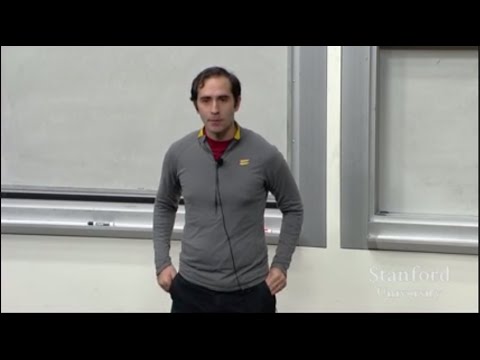
Lecture 11 - Hiring and Culture, Part 2 (Patrick and John Collison, Ben Silbermann)
Early hires and deliberate transparency set the culture that resolves bandwidth problems as startups scale beyond founder oversight.
Key takeaways
7 points- 1Culture is defined by hires, daily actions, communications, and celebrations.
- 2The first ten employees shape all future hiring and norms.
- 3Work with candidates for a week before making offers.
- 4Use quantitative references asking for percentile rankings.
- 5Build autonomous teams that operate like many small startups.
- 6Preserve transparency through written channels even at scale.
- 7Hire a recruiter early to support referral-driven growth.
Summary
This lecture captures Stripe and Pinterest founders on building durable culture through intentional early hiring and transparency systems that let companies scale without founder bottlenecks.
Core Elements of Culture
- Culture forms from who you hire, daily actions, communications, and celebrations rather than top-down declarations (0:01-10:04).
- Transparency serves as the key invariant that enables collaboration when founders can no longer review every decision.
Early Hiring as Value Investing
- Treat the first ten hires as the highest-leverage decisions because each brings many future teammates (9:59-20:02).
- Seek undervalued talent with traits like finishing tasks, caring about details, low ego, and genuine curiosity.
Assessment and Onboarding Tactics
- Work with candidates for a full week and run quantitative references asking for top-1% or top-5% rankings (19:59-30:02).
- Onboard by assigning real problems immediately and reinforcing long-term vision.
Scaling Autonomy and Transparency
- Structure teams as many small startups with self-contained skills instead of monolithic departments (29:58-40:01).
- Maintain transparency via evolving tools even as email volume grows, accepting short-term overload for long-term alignment.
Deep read
Executive Summary
This lecture (Lecture 11: Hiring and Culture, Part 2) features Ben Silbermann (Pinterest) and John & Patrick Collison (Stripe) sharing pragmatic, experience-based insights on building culture, hiring early, onboarding, and scaling teams from a few dozen to hundreds. The core premise is that culture is the practical mechanism that scales a company’s capacity to execute as headcount grows. The speakers outline four core dimensions of culture (who you hire and what they value; daily activities; what you communicate; what you celebrate/punish) and argue that transparency is a foundational pillar that aligns mission with daily work. They frame culture as a bandwidth-management tool: as a startup grows, founders’ direct involvement in every decision inevitably shrinks, so culture provides the invariants that keep the organization coherent.
A key portion of the talk delves into hiring the first 10 employees—who they were, what traits they possessed (hard work, high integrity, low ego; curiosity and creativity; genuine care and willingness to take risks), and how those hires were selected in the face of a weak external pull. The discussion emphasizes “gardening” as an analogy for culture: you plant seeds (hires), weed out what doesn’t work, and nurture what grows, recognizing that these initial hires effectively seed the organization’s future. The panel discusses practical recruiting tactics: inductive hiring, leveraging undervalued early-career talents, and calibrating with world-class benchmarks by consulting known experts.
As the companies scale, the conversations focus on autonomous, modular teams—often called “a startup of many startups.” Pinterest and Stripe aim to assemble cross-disciplinary, self-contained teams anchored to a project, with the autonomy to move quickly and with clear success metrics. Referrals grow in importance, and adding a professional recruiter becomes a strategic decision to sustain growth. On onboarding, the talk evolves from informal, relationship-based ramp-ups to structured, week-long programs with 30-day feedback loops to measure integration and productivity. Finally, the talk touches on authenticity in recruiting, the tension between risk and reward, and how vision must be concrete but honest about hard work and uncertainty. The panelists provide concrete anecdotes, candid reflections on failures and successes, and a shared conviction that culture, hiring, and onboarding are the most consequential levers for successful scale.
00:00:01 Introduction and guests
Speaker: Patrick Collison: part two of culture and team and we have Ben Silberman the founder of Pinterest and John and Patrick Collison the founders of stripe um Founders that have obviously sort of some of the best in the world at thinking about culture and how they build teams so there's three areas that we're going to cover today one will just be sort of General thoughts on culture as a follow-up to the last lecture and then we're really going to dig into what happens at the founding of these companies and and building out the early team and then how that changes and evolves uh as these guys have scaled their companies up to you know 100 plus I don't even know how many people you have now but quite a lot the very large organizations and how you adapt these principles of culture
Speaker: Patrick Collison: but to start off I just want to uh ask a very open in a question which is what are the core pieces of culture that you found to be most important in building out your companies start sure what are the what are the most important parts
00:00:15 Core pieces of culture (four dimensions)
00:00:22 Major ideas
- SPEAKER: Patrick Collison lays out four core dimensions of culture he and his co-founders focus on:
- Who you hire and what those people value - What you do every day (the daily drivers and motivation) - What you choose to communicate - What you choose to celebrate (and conversely, what you punish)
- They emphasize that culture should be built around celebration rather than punishment, and that emphasis on these four areas drives organizational behavior.
- They highlight transparency as a foundational pillar for Stripe, arguing that aligned mission plus access to information significantly improves productive collaboration.
Quote: "in general I think running a company based on what you celebrate is more more exciting than what you punish" Timestamp: 00:00:55 Speaker: Patrick Collison
- Transparency is described as both valuable and sometimes misunderstood; it enables alignment and helps overcome many growth-friction issues as the company scales.
- They note the challenge of information overload at scale and discuss tooling (Slack, email, etc.) as part of the transparency architecture.
Quote: "we've placed a large emphasis on transparency internally... it's something that's been really valuable for stripe" Timestamp: 00:01:40 Speaker: Patrick Collison
00:01:40 How culture acts as a bandwidth solution
- Culture is framed as a mechanism to manage bandwidth growth: as a company expands, you cannot be involved in every decision; culture encodes invariants so teams can operate autonomously.
- The metaphor: early on, founders can be deeply involved in many decisions; with growth, culture helps sustain coherence when direct founder involvement naturally diminishes.
- This view positions culture as a necessary constraint to enable scale without collapsing due to complexity.
Quote: "culture is kind of how you uh kind of what the strands are that you sort of want to have the invariance that you want to kind of maintain as you can get" Timestamp: 00:02:40 Speaker: Patrick Collison
00:02:55 How Stripe thinks about transparency at scale
- As Stripe grew from 2 to 170+ people, they invested in tools and processes to sustain transparency without overwhelming individuals with information.
- The company emphasizes access to information and clear pictures of the current state to align efforts and maintain productivity.
Quote: "if everyone really believes in the mission and then if everyone has really good access to information and kind of has a good picture of the current state of stripe" Timestamp: 00:03:25 Speaker: Patrick Collison
00:03:50 Hiring the first 10 and the “gardening” analogy
00:04:05 The first hires as a proxy for future culture
- The hosts discuss how the first 10 hires are critical since they effectively set the tone and recruit a broader pool of ~100 people through their own networks.
- Early hiring is described as deeply inductive: founders hire people they want to work with and who they believe are talented.
- The analogy: culture is more like gardening than architecture — you plant seeds, pull weeds, and nurture what grows; the initial hires seed future culture.
Quote: "the first 10 people you hire... you're actually hiring a 100 people because you should think of kind of each one of those people as bringing along sort of another 10 people" Timestamp: 00:04:40 Speaker: Ben Silbermann
00:05:20 What founders look for in the first hires
- Patrick describes his criteria for early hires: hardworking, high integrity, low ego; creative and curious; multi-disciplinary, quirky individuals who love building something big and are willing to take risks.
- He shares anecdotes about first hires with unusual hobbies and creative side-projects (e.g., board games, magic tricks) as indicators of creative, cross-disciplinary thinking.
- The emphasis is on people who care deeply about creating something meaningful and are not arrogant about it.
Quote: "we looked for people that worked hard and seemed high integrity and low ego... people that were creative and that usually meant they were really curious" Timestamp: 00:05:50 Speaker: Ben Silbermann
- They note the difficulty of hiring early when the company has little external pull (tiny office, uncertain salary, low visibility).
- Founders often had to recruit through personal networks, friends of friends, and undervalued early-career individuals who could grow with the company.
Quote: "the early days we had this horrible office like nobody got paid... there was every reason not to join" Timestamp: 00:06:40 Speaker: Ben Silbermann
00:07:20 Hiring strategy and the “undervalued” talent
- The speakers discuss the idea of seeking undervalued talent—people who are not yet recognized by the market but have significant potential.
- John and Patrick note that you should look for people who are genuinely excited by hard problems and who will contribute beyond their immediate skillset.
00:08:30 Talent identification tactics
00:08:45 Known frameworks and calibration
- The speakers emphasize the importance of calibrating your sense of world-class talent by talking to known world-class practitioners and extracting the traits and interview questions that reveal true capability.
- They advise asking how to identify the right people and what questions to ask to differentiate quality; they also stress pre-calibration to minimize the cost of mis-hiring.
Quote: "I always made it a habit of talking to people that I knew de facto were world class and then asking them specifically what are the key traits or characteristics that you look for" Timestamp: 00:10:15 Speaker: John Collison
00:09:59 Interviewing and screening for quality
- The interview process evolves with company growth; there is a rotating set of standard questions used to gauge quality and to reveal whether the role is a good fit for the candidate.
- They stress openness about how hard the role will be and to target people who want to solve difficult problems.
Quote: "we have an evolving set of standard questions... to give a sense for is this the right place for that person to come and work" Timestamp: 00:11:25 Speaker: John Collison
00:11:15 Practical interview approaches
- They discuss adapting interview methods to fit the role and the founder’s strengths, including hands-on trial experiences for non-technical roles (e.g., engineering-like assessment for business development).
- Stripe’s first engineer example: flying the candidate out and coding together for a weekend to truly test capabilities, rather than relying solely on whiteboard sessions.
Quote: "for our first engineer we flew the guy out and we spent a weekend coding with him... that was the only way we could really tell" Timestamp: 00:14:40 Speaker: Patrick Collison
- They emphasize that hiring is expensive, so it’s critical to build a process that stops bad hires early and scales with the company.
00:12:50 On onboarding and ramping early hires
00:12:55 Onboarding the first hires and managing expectations
- Early onboarding is informal and automatic: there is continuous relationship-building that naturally occurs in a small team.
- As the company grows, onboarding becomes more formal with structured programs, 30-day check-ins, and cross-team introductions.
- They describe a 1-week initial ramp with role-specific follow-ups and emphasize the importance of making new hires feel like part of the whole mission, not just a single task.
Quote: "we would always try to remind people of where we wanted to go someday..." Timestamp: 00:15:25 Speaker: Patrick Collison
- They describe a 30-day feedback loop involving the new hire, their peers, and their manager to assess productivity and cultural fit; if a team isn’t able to bring new hires up to speed, it signals a need to rethink that team’s hiring process.
Quote: "30 days afterwards and then we also asked their peers and their manager... if we haven't, that's a key signal that that team shouldn't be hiring" Timestamp: 00:16:50 Speaker: John Collison
- Personal awareness and individual working style are also considered in onboarding to demonstrate care for the person beyond job duties.
Quote: "get to know the person as a person... what are their aspirations, what's their working style" Timestamp: 00:17:20 Speaker: Ben Silbermann
00:18:30 From startup to scale: autonomy and “startup of many startups" philosophy
00:18:50 Scaling culture and autonomy
- The goal as Stripe and Pinterest grow is to make teams feel autonomous and nimble within a large organization, effectively creating many startups within one company.
- Teams should control the resources they need, know what the most important thing is, and be empowered to move fast; management becomes easier if work is decomposed into autonomous units.
- Pinterest emphasizes cross-functional, self-contained units that include a designer, an engineering leader, a writer, and sometimes a community manager; teams anchor on a single project and are empowered to push quickly.
Quote: "the goal is to make the teams feel as autonomous and nimble as possible within the constraints of having a large organization" Timestamp: 00:19:30 Speaker: Patrick Collison
- Hiring evolves with scale; referrals become increasingly important as a primary source of new talent; hiring processes are supported by a professional recruiter who specializes in startup pipelines.
Quote: "referrals become like more and more the lifeblood... and we hired a professional recruiter early on" Timestamp: 00:21:50 Speaker: Ben Silbermann
00:22:30 Time horizons, growth, and the “three meals a day” culture
00:22:40 Time horizons change with scale
- Early on, leaders think only 1-2 months ahead; as the company grows, horizons extend to a year and beyond. Leadership must anticipate longer-term needs and structures.
- Growth makes it essential to think about talent pipelines that can sustain multi-year plans; short-term fixes no longer suffice.
Quote: "the time horizons change... after one year you're thinking one year ahead... after four years you're thinking four years ahead" Timestamp: 00:29:58 Speaker: Ben Silbermann
- Culture at scale requires deliberate rituals to maintain connection; Stripe’s approach includes three meals a day at long tables to increase cross-team interaction and to simulate startup intimacy.
Quote: "three meals every day at sort of long tables where kind of everyone can sit together" Timestamp: 00:29:58 Speaker: John Collison
00:24:20 Scaling transparency tools and norms
- Stripe scaled transparency with structured All-Hands meetings and a formal information architecture; the company built a deck-driven approach to communicate company-wide progress.
- The culture must evolve with norms for how information is shared (e.g., handling confidential data, the stage of sharing, and the risk of overexposure).
Quote: "we've built an increasingly intricate framework of mailing lists... All Hands with a deck" Timestamp: 00:32:10 Speaker: Patrick Collison
00:34:50 Audience Q&A highlights
00:35:00 Leadership pathways for early employees
- Question: Have early hires grown into leadership roles? Stripe says yes for many; Pinterest also observes a mix of outcomes. Leadership development is not guaranteed and requires deliberate effort.
- Ben notes that some early hires become leaders; others prefer individual contributor roles; both paths can matter.
Quote: "yes, in Stripe quite a number of the first 10 people are in leadership roles now" Timestamp: 00:39:58 Speaker: Patrick Collison
00:39:58 Vision evolution and product strategy
- John discusses how vision can shift over time; discovery and recommendations become central to the product—leveraging data and human curation. Pinterest’s approach to discovery has expanded to feed, search, and recommendation systems as core strategic bets.
- Ben notes the surprise that user growth has been broad and diverse, far exceeding initial expectations; the product direction expands with usage and the company’s ambitions.
Quote: "looking at other people's collections turns out to be this really amazing way to discover things" Timestamp: 00:16:10 Speaker: Ben Silbermann
00:41:20 Authenticity in recruitment
- The panel discusses authenticity in candidates: avoid over-promise or cultivating a false sense of certainty; successful hires are those who seek real impact, take on meaningful challenges, and are comfortable with uncertainty.
- When interviewing, they advise asking about candidates’ genuine motivations, not just resume highlights or perks sought.
Quote: "If you're telling them that and they select in like they like you probably shouldn't hire them because they didn't pass like a basic intelligence test about uncertainty" Timestamp: 00:52:25 Speaker: Patrick Collison
00:45:00 Closing thoughts
00:45:10 Final reflections on culture and scale
- The speakers emphasize that culture is the backbone of scaling startups and that transparent, autonomous teams are central to sustainable growth.
- The conversation ends with appreciation for the human factors behind successful companies—talent selection, onboarding, and continuous development.
Quote: "Don't screw it up... the 99.9% of what our companies do is being done by people who are not us" Timestamp: 00:58:00 Speaker: John Collison
00:46:10 Thanks and sign-off
- The hosts thank the guests for sharing candid insights into culture, hiring, and scaling; the session closes with gratitude for practical guidance from experienced founders.
Quote: "thank you guys very much for coming in today thank you" Timestamp: 01:00:00 Speaker: Patrick Collison
Resources Mentioned
- Slack
- Gmail
- Hackpad
- All Hands (company-wide meetings)
- Google / Google X
- iPhone (Apple)
- PayPal
- MasterCard
- Uber
- Airbnb
- Dropbox
- Stripe
- Craigslist
- Palato (coffee shop reference)
- Koopa (coffee shop reference)
- 10x talent concept (metaphor for superstar performers)
- Gmail filters (tooling to manage information flow)
- 3 meals a day culture (Stripe)
- All the above brands and platforms in context of discussing hiring, culture, and scaling
Notable terms and concepts explained
- Transparency: sharing information broadly within the company to align effort and reduce miscommunication.
- All Hands: a company-wide meeting designed to share crucial updates, usually with a slide deck.
- Autonomy: giving teams the freedom and resources to operate like small startups within a larger organization.
- Bandwidth problem: as an organization grows, the number of decisions founders can directly influence decreases; culture helps scale decision authority.
- First 10 hires: the initial set of employees who collectively shape future culture and set hiring expectations for the rest of the company.
- Spin-up: a ramp period or process to onboard new hires and bring them up to speed.
- Refer (references): contacting former managers or colleagues to gauge a candidate’s fit and abilities.
- Time horizons: the shift from short-term (weeks to months) to long-term (years) planning as a company scales.
- Cross-disciplinary teams: units composed of people with multiple disciplines (design, engineering, writing, etc.) working together on a shared project.
Glossary
- All Hands: A company-wide gathering to disseminate updates, celebrate progress, and align on goals.
- Hackpad: A collaborative document tool used for internal notes and collaboration (a precursor to modern wikis).
- Transparency: Open sharing of information across an organization to align goals and reduce uncertainty.
- Spin-up: The initial onboarding and ramp-up period for a new hire.
- 10x Talent: A heuristic referring to individuals who are exceptionally productive or influential within their peer group; not a fixed metric.
- Autonomous teams: Teams empowered with decision rights and resources to move quickly without micromanagement.
- Referral-based hiring: Sourcing candidates via employee and personal networks rather than external job postings.
Notable quotes (verbatim)
- "> I think running a company based on what you celebrate is more more exciting than what you punish"
Timestamp: 00:00:55, Speaker: Patrick Collison
- "> if everyone really believes in the mission and then if everyone has really good access to information and kind of has a good picture of the current state of stripe"
Timestamp: 00:03:25, Speaker: Patrick Collison
- "> the first 10 people you hire... you're actually hiring a 100 people because you should think of kind of each one of those people as bringing along sort of another 10 people"
Timestamp: 00:04:40, Speaker: Ben Silbermann
- "> we flew the guy out and we spent a weekend coding with him... it was the only way we could really tell"
Timestamp: 00:14:40, Speaker: Patrick Collison
- "> yes, in Stripe quite a number of the first 10 people are in leadership roles now"
Timestamp: 00:39:58, Speaker: Patrick Collison
Topics
- Hiring
- Culture
- Startup Growth
- Transparency
- Leadership & Management
- Product Discovery
- Onboarding & Team Autonomy
- Referrals
Action Items
- Define and publish the four core cultural dimensions for your startup (hiring values, daily work, communication, celebration/punishment).
- Invest in transparency tools and processes (Slack, email practices, All Hands) and establish a sustainable pattern (e.g., weekly updates, clear routing for information).
- Design an onboarding program that scales: a 1-week ramp plus 30-day reviews involving peers and managers to assess fit and productivity.
- Prioritize the first 10 hires as a cultural cornerstone; document traits and create a plan for how they will onboard others.
- Develop a playbook for identifying world-class talent: interview questions, calibration standards, and a process to obtain qualitative references.
- In early hiring, incorporate hands-on assessments relevant to the role (not just generic interviews) to verify capabilities.
- Encourage cross-disciplinary, autonomous teams anchored to a project; ensure teams have the resources and decision rights to move fast.
- Establish a formal referral program and hire a professional recruiter early to scale the pipeline.
- Be transparent about the hard aspects of joining and set expectations about workload, travel, or time commitments.
- Measure onboarding success through feedback from new hires, their peers, and managers; use results to adjust teams’ hiring and ramp practices.
- Balance transparency with confidentiality; set norms for what information is shared, when, and with whom, especially at scale.
Mental Models
Glossary
- Transparency
- Open sharing of information across the organization to align goals, reduce uncertainty, and improve collaboration.
- All Hands
- A company-wide meeting intended to share updates, celebrate progress, and align on strategy.
- Autonomy
- Empowering teams with decision rights and resources to act quickly and independently within the company’s overall goals.
- Spin-up
- A ramp period for new hires to become productive contributors; often includes structured introductions and training.
- 10x Talent
- A heuristic for an individual who is exceptionally capable or productive relative to their peers; not a fixed metric.
- Cross-disciplinary Team
- A team composed of members from different functional areas (design, engineering, writing, etc.) working together on a single project.
Notable Quotes
“I think running a company based on what you celebrate is more more exciting than what you punish”
“if everyone really believes in the mission and then if everyone has really good access to information and kind of has a good picture of the current state of stripe”
“the first 10 people you hire... you're actually hiring a 100 people because you should think of kind of each one of those people as bringing along sort of another 10 people”
“we flew the guy out and we spent a weekend coding with him... that was the only way we could really tell”
“yes, in Stripe quite a number of the first 10 people are in leadership roles now”
“looking at other people's collections turns out to be this really amazing way to discover things that you didn't know you were looking for”
“Thank you guys very much for coming in today thank you”
Topics
More from How to Start a Startup (YC)
See all