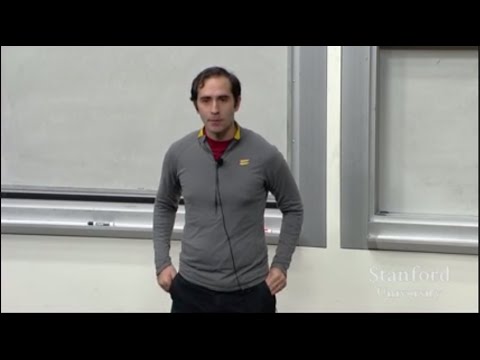
Lecture 13 - How to be a Great Founder (Reid Hoffman)
Great founders win with narrow superpowers, a testable investment thesis, and adaptive teams rather than mythical genius.
Key takeaways
7 points- 1Reject the solo super-founder myth; recruit co-founders who cover your weaknesses.
- 2Form a clear investment thesis and update it with market data.
- 3Take focused risks where one correct assumption creates multiple wins.
- 4Prioritize financing and distribution above product perfection.
- 5Persist when data increases confidence; pivot when it does not.
- 6Build teams that challenge each other to find truth, not agreement.
- 7Maintain intense focus on winning rather than conventional life balance early on.
Summary
Reid Hoffman explains how to be a great founder by rejecting the superhuman myth and focusing on targeted strengths, contrarian theses, and team execution.
Myth of the Super Founder
- No founder possesses universal superpowers; success stems from a few relevant edges plus co-founders who compensate for weaknesses (0:00-10:01).
- Two or three co-founders outperform solo founders through diverse skills and shared problem-solving.
Contrarian Thinking
- Being contrarian means smart experts would disagree, not just uninformed people; it requires knowing something others do not (9:58-20:00).
- An investment thesis guides when to persist versus pivot based on rising or falling confidence.
Intelligent Risk and Adaptation
- Take focused risks where one correct assumption unlocks multiple wins; continuously test the thesis against market data (19:57-29:59).
- Prioritize financing and distribution over the raw product idea.
Founder Qualities and Teams
- Clarity of vision, persistence on the thesis, and the ability to attract networks matter most (29:56-39:58).
- Strong co-founder teams collaborate, challenge assumptions, and seek truth rather than agreement.
When to Pivot
- Pivot when confidence drops and efforts to raise it fail; avoid seeking conventional balance in early stages (39:56-49:40).
Deep read
Executive Summary
Reid Hoffman’s Lecture 13 reframes the founder narrative from the ideal of a singular ‘superperson’ to a pragmatic, team-based, network-driven approach to building startups. The talk emphasizes that success comes from assembling complementary co-founders, choosing the right location for the problem, practicing disciplined contrarian thinking anchored in credible insight, and balancing bold, intelligent risk-taking with rigorous feedback loops. A recurring theme is the interplay between vision and data: founders must articulate a clear investment thesis, test it with smart feedback, and pivot when evidence suggests it will increase the likelihood of achieving the long-term North Star. Hoffman also stresses the importance of product distribution, iterative learning, and maintaining flexibility across paradoxes (e.g., being persistent yet adaptable, prioritizing external networking while continuing internal development). The discussion uses LinkedIn and PayPal as primary case studies to illustrate how a vision can persist while tactics evolve in response to market signals, and how teams and networks—not lone genius—drive durable success. The talk closes by underscoring that great founders come from diverse backgrounds and that a co-founder team with high trust and effective collaboration is often the core determinant of success in the startup journey.
00:00:00Major Topic
Subtopic
- The lecture opens by reframing the founder's identity. Reid Hoffman challenges the common image of the founder as a 'Superperson' who excels at every possible startup skill. He questions the myth of the founder as a panoply of universal competencies (product, market, strategy, management, fundraising, etc.). The speaker emphasizes that founders deal with many headaches and that no one is universally superpowered. The tone sets up a distinction between the romantic, mythic view of founders and the practical, portfolio-like reality of entrepreneurship.
- Key idea: great founders are not defined by being perfect at every skill, but by how they assemble strengths on a team, how they leverage networks, and how they navigate uncertainty. The concept of 'competition edge' and edge cases is introduced early, signaling that differentiation often comes from unique capabilities rather than flawless execution across all domains.
Quote: "the reality right is a Founder is someone who deals with a ton of different headaches and um and no one is universally superpowered" (00:00:00)
- The speaker introduces the concept that “superpowers” are often distributed unevenly across a founding team and that competitive edge is a function of problem- and context-specific strengths rather than pure genius. He also hints at the idea that sometimes what looks like genius is later deemed madness, and vice versa, underscoring the uncertainty of early entrepreneurship.
00:09:58Major Topic
SubtopicContrarian Thinking and Audience Relative Skepticism
- Hoffman reframes contrarian thinking as not merely opposing the crowd, but being willing to be contrarian relative to a specific, informed audience. A truly contrarian stance should be grounded in something a smart, knowledgeable group might not see. The contrarian position depends on what the founder knows that others do not know and how that insight can translate into a defensible investment thesis.
- He argues contrarian positions are only valuable if they are anchored to a plausible counterpoint that could be validated by intelligent feedback loops (talking to smart people, testing hypotheses, etc.). The idea is to obtain feedback from people who are more expert or more knowledgeable to stress-test the thesis rather than simply seeking agreement.
- Reid gives LinkedIn as a case study: early critiques suggested the concept wouldn’t scale (network value is strongest only when large number of people are on the network). He explains that his counter-strategy combined a vision for a broad professional network with a plan to reach a critical mass through non-obvious channels, thereby turning skepticism into validation over time.
Quote: "Contrarian is relative to an audience... what would other say it's not yet a good idea?" (00:09:58)
- Practical takeaway: to assess contrarian strategies, founders should articulate what they know that others don’t know and then seek feedback from intelligent skeptics to see if there’s a plausible path to validation.
00:19:57Major Topic
SubtopicRisk, Investment Thesis, and Balancing Belief with Evidence
- A core theme is the balancing act between persisting with a vision and staying responsive to data and feedback. Founders should craft an investment thesis for their company that enumerates why the idea might work (the edge they have, the problem they address, the market dynamics) and then repeatedly test this thesis against new data.
- Hoffman emphasizes that courage and risk-taking are essential, but the riskiest move is unreasonable, unfocused risk. The path to success often requires intelligent, focused risks that, if proven right, would unlock a cascade of favorable outcomes. He illustrates this with PayPal’s pivot away from a Palm Pilot-based cash model toward email-driven payments as the backbone, showing how a series of incremental bets can lead to a better overall model.
- The PayPal example underscores how a founder’s vision can persist while tactics shift in response to empirical signals. The team tested an idea (cash on mobile devices/Palm Pilots) and pivoted to a different mechanism (email payments) when signals suggested it would be more viable. That pivot preserved the North Star while changing the route to reach it.
- He stresses a dual-thread approach: maintain a clear long-term vision while remaining relentlessly data-driven in the short term. The data exists within the framework of a vision; even negative data can be informative about a necessary pivot if it reinforces the core direction and its feasibility.
- On risk tolerance, Hoffman distinguishes between reckless risk and intelligent risk. The aim is to identify one or more high-impact bets that, if correct, will unlock related opportunities. He uses the metaphor of building the airplane while falling off the cliff to describe the startup journey — where the emphasis is on strategic risk that maximizes the chances of success given the unknowns.
Quote: "the only really big opportunities the only contrarian opportunities smart people disagree with you on happen to be one that have risks associated with them" (00:19:57)
- The role of data is reframed: data informs and updates the investment thesis but does not replace vision. A founder’s hypothesis should be explicit, testable, and revisable in light of new information, while still anchored to a north star.
- The PayPal example also includes a lighter anecdote about a T-shirt campaign and the concept of a universal network for payments, illustrating how vision, branding, and product evolution intertwine to support an investment thesis and product strategy.
00:29:56Major Topic
SubtopicTeam, Co-founders, and Networked Organization
- Hoffman argues that two or three co-founders are typically better than a lone founder. Multiple founders bring complementary skills, provide mutual reinforcement, and help cover a broad skill set required to navigate the early chaos of a startup. A critical caveat is that co-founders must have high trust and effective conflict resolution, because survival often hinges on enduring difficult, high-stress dynamics.
- The risk of a founder dispute is highlighted as a common and potentially fatal problem. He stresses the importance of trust and a framework for addressing disputes before they become intractable, including setting expectations, defining decision rights, and rehearsing scenarios where the partnership might fail and how to manage it gracefully.
- He discusses the role of location and networks: Silicon Valley offers strong networks and talent pools for certain problem spaces, but that does not make it the optimal location for every startup. The right location depends on the problem, the required network effects, and the specific strengths of local ecosystems. In some cases (e.g., Groupon), non-Valley networks (like Chicago's sales force) have been critical for success. The underlying idea is to locate where networks crucial to the problem are strongest, recognizing that networks and talent cluster differently by domain.
- He cautions against assuming Silicon Valley is universally best for all types of startups, using Groupon as a cautionary example where sales networks and a non-software-intensive path were essential to early traction, despite being a software product.
Quote: "Groupon... could not have been founded here... required to be actually in Chicago" (00:00:??)
- The concept of 'jumping off a cliff and assembling an airplane on the way down' is revisited as a mental model for balancing speed, risk, and learning in a resource-constrained environment. Founders should be willing to relocate to leverage the strongest networks for their problem, recognizing that network access is a material part of competitive advantage.
00:39:56Major Topic
SubtopicFinding Great Founders and Evaluating Co-founder Fit
- Hoffman emphasizes that diversity of strengths (technical, business, fundraising, network-building) is critical. He notes that different sectors require different core competencies (e.g., software vs. hardware, consumer vs. enterprise) and that the right co-founder mix depends on the domain. He also broadens the definition of diversity beyond gender/race to include age and varied experiences (e.g., Jack Ma as a teacher-turned-entrepreneur) to illustrate that nontraditional background can be a powerful advantage.
- The speaker stresses the importance of collaboration, robust trust, and the ability to collectively pursue truth. Teams should challenge each other constructively, bring up opposing viewpoints, and navigate disagreements to reach a shared, evidence-based path forward.
- He discusses practical steps for evaluating co-founders and teams: invest time to understand working styles, decision-making, and conflict resolution. He recommends deep, time-consuming conversations (20+ hours) to surface beliefs, work styles, and potential points of contention, covering scenarios that could threaten the partnership (e.g., how to handle disagreements about the path and goals). The goal is to establish a shared language for addressing conflicts early so that, under stress, teams can still problem-solve rather than fracture.
- He notes the dangers of partnerships that rely on personal dynamics (e.g., husband-wife teams) due to added emotional complexity. The core requirement is not mere compatibility, but a demonstrated ability to collaborate toward truth and to adapt to changing realities and risks.
- Finally, he reiterates that there is no single universal founder profile. Great founders can come from diverse backgrounds, ages, and experiences, depending on the product and market. The emphasis is on how well they can build networks, assemble complementary strengths, learn continuously, and navigate uncertainty together.
Resources Mentioned
- startupclass.samaltman.com/courses/lec13/
- https://startupclass.co/courses/how-to-start-a-startup/lectures/64042
- PayPal, LinkedIn, Groupon as case studies discussed throughout
- Palm Pilot (early PDAs) as a pivot reference point
- BTC/Bitcoin as a discussion point for distributed trust and currency-like systems
- References to the broader startup/tech ecosystem (Silicon Valley networks, etc.)
Visuals and Diagrams (described)
- A slide deck is referenced, illustrating key skills and the myth of the founder as a single “superperson.” The slides likely structured a list of essential capabilities (team, location, contrarian thinking, etc.) and how they interact rather than presenting a single best-practice path.
- A network-map concept is implied when discussing Silicon Valley versus other hubs for different types of startups (e.g., Groupon’s Chicago-based sales network). Recreating such a visual would entail mapping problem domains to optimal geographic networks (talent, customers, partners).
- A mental model diagram is described in text: balancing paradoxes (flexible/persistent, belief/fear) and the interaction between vision and data, as well as short-term actions vs. long-term aims.
Notable Lines (Verbatim in Blockquotes)
The reality right is a Founder is someone who deals with a ton of different headaches and um and no one is universally superpowered Contrarian is relative to an audience... what would other say it's not yet a good idea? the only really big opportunities the only contrarian opportunities smart people disagree with you on happen to be one that have risks associated with them jumping off a cliff and assembling an airplane on the way down we are creating a kind of universal Network that allows anyone to pay anyone to become a merchant
00:52:00Resources Mentioned
Resources Mentioned
- startupclass.samaltman.com/courses/lec13/
- https://startupclass.co/courses/how-to-start-a-startup/lectures/64042
- PayPal, LinkedIn, Groupon (case studies referenced)
- Palm Pilot (early PDA) reference point for the PayPal pivot
- Bitcoin and distributed trust as a future area of discussion
- Creative Commons license for the video: http://creativecommons.org/licenses/by-nc-nd/2.5/
Glossary of Key Concepts (introduced or clarified)
- Founder: The person or people who start a company and are responsible for its vision and early strategy.
- Co-founders: Founding partners who share responsibility for building the company; two to three founders is often better than a solo founder due to complementary skills and risk-sharing.
- Investment Thesis: A concise, testable hypothesis about why a startup will succeed, including the edge the team has, how the market will evolve, and how the product distribution will enable growth.
- Product Distribution: How a product gets from the team to customers; prioritizing distribution often matters more than product perfection in early stages.
- Contrarian Thinking: The ability to hold a view that differs from mainstream opinion, grounded in a credible rationale and testable via feedback from knowledgeable audiences.
- Paradoxes in Founding: The need to balance seemingly opposing demands (flexibility vs. persistence; belief vs. data; internal work vs. external network-building).
- Master Merchant Model (PayPal context): A payment network approach where a merchant or platform enables payments across a broad base of users; a pivot example demonstrates how business models adapt while preserving the core vision.
- Network Effects: The phenomenon whereby a product becomes more valuable as more people use it; often a critical factor in scaling software platforms.
- Local vs. Global Network Strategy: The idea that different problem spaces may require locating in different ecosystems to leverage the strongest supporting networks.
00:52:00Quotes (Selected)
- "the reality right is a Founder is someone who deals with a ton of different headaches and um and no one is universally superpowered" — Reid Hoffman (00:00:00)
- "Contrarian is relative to an audience... what would other say it's not yet a good idea?" — Reid Hoffman (00:09:58)
- "the only really big opportunities the only contrarian opportunities smart people disagree with you on happen to be one that have risks associated with them" — Reid Hoffman (00:19:57)
- "jumping off a cliff and assembling an airplane on the way down" — Reid Hoffman (00:09:58)
- "we distributed these t-shirts that said the new Global world currency" — Reid Hoffman (00:29:56, PayPal context)
- "we are creating a kind of universal Network that allows anyone to pay anyone to become a merchant" — Reid Hoffman (PayPal context; paraphrased in description)
00:52:00Topics
- Great Founders
- Startup Strategy
- Contrarian Thinking
- Co-Founder Dynamics
- Investment Thesis
- Product Distribution
- Network Effects
- Location and Ecosystems
Action Items
- Identify 2–3 potential co-founders with complementary strengths and initiate deep, 20+ hour dialogue to explore values, working styles, and conflict resolution strategies.
- Draft a one-page investment thesis for your startup: the problem, the edge, the market, and the core path to traction.
- Map the most important distribution channels for your product and design a plan to test them within 4–6 weeks.
- Assess your location strategy: where are the strongest networks for your domain, and what would relocating or staying entail?
- List 3 hard hypothesis and 3 escape hatches; outline triggers that would prompt a pivot.
- Schedule regular, structured feedback sessions with mentors or smart peers to stress-test your contrarian theses.
- Create a risk-focused execution plan: identify one intelligent risk to pursue that could unlock multiple downstream benefits.
- Document decision rights and a ‘divorce clause’ style plan for co-founders to minimize future conflict.
- Develop a long-term vision with a parallel short-term plan; ensure incremental milestones align with the vision.
- Actively seek diverse perspectives (backgrounds, ages, experiences) to broaden strategic options.
Mental Models
Glossary
- Founder
- The person (or people) who starts a company and sets its initial vision and strategy.
- Co-founders
- Partners who start the company with you, offering complementary skills and shared risk.
- Investment Thesis
- A concise rationale describing why a startup will succeed, linked to evidence and a growth plan.
- Product Distribution
- Ways a product reaches users and customers; often a critical factor in startup growth.
- Contrarian Thinking
- Holding a position that runs counter to the prevailing view, but grounded in credible insight and tested with experts.
- Master Merchant Model
- A PayPal-related concept where a merchant network enables broad payments; discussed as a pivot and business model exploration.
- Network Effects
- A phenomenon where a product becomes more valuable as more people use it, creating a compounding growth effect.
- North Star Vision
- The long-term, ultimate goal or direction that guides strategy and decisions, even as tactics adapt.
Notable Quotes
“the reality right is a Founder is someone who deals with a ton of different headaches and um and no one is universally superpowered”
“Contrarian is relative to an audience... what would other say it's not yet a good idea?”
“the only really big opportunities the only contrarian opportunities smart people disagree with you on happen to be one that have risks associated with them”
“jumping off a cliff and assembling an airplane on the way down”
“we distributed these t-shirts that said the new Global world currency”
“we are creating a kind of universal Network that allows anyone to pay anyone to become a merchant”
Topics
More from How to Start a Startup (YC)
See all