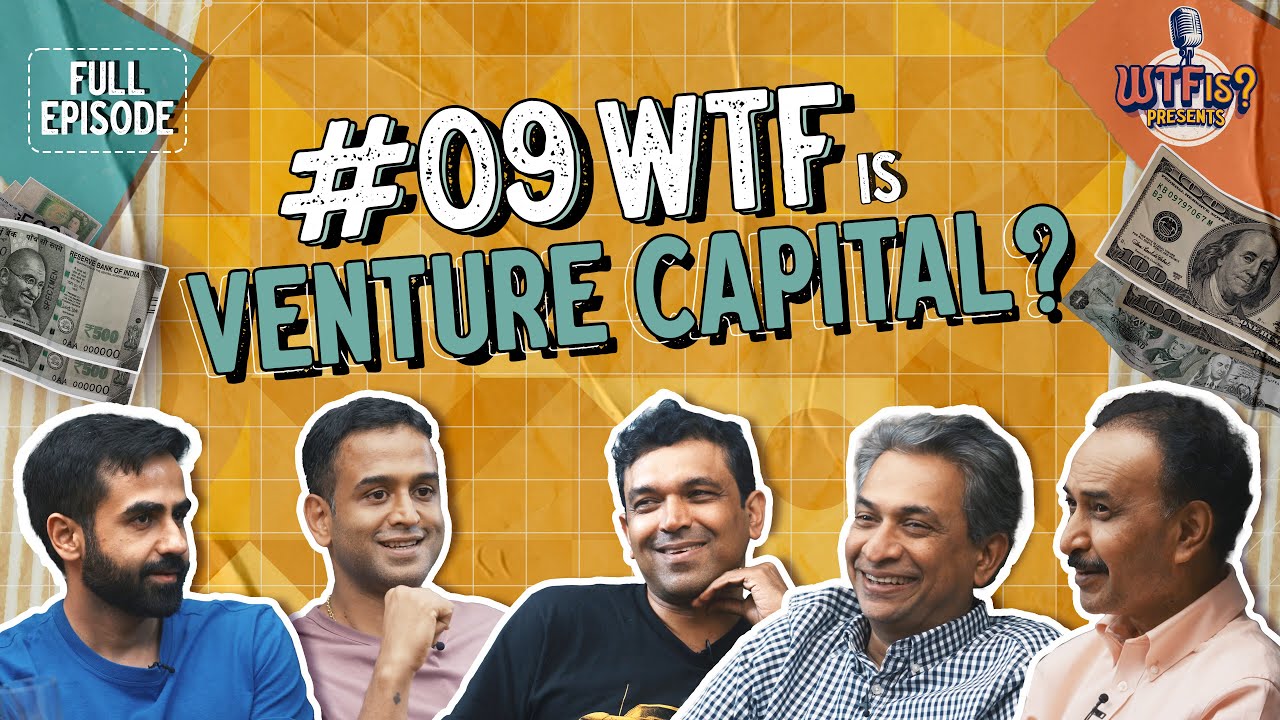
Ep #5 | EdTech What’s Broken, What’s Next? With Nikhil, Ronnie Screwvala , Gaurav Munjal & Jay Kotak
Indian founders share how Unacademy and UpGrad turned competitive exams and lifelong skills into scalable businesses while debating balance, capital, and the future of learning.
Key takeaways
5 points- 1Build for outcomes that change lives or careers, not just content delivery.
- 2Accept multiple failures when each success can return 10-20x value.
- 3Shift from rote, conformist schooling to gamified, peer-driven, non-linear learning.
- 4Use less capital and retain ownership to create durable companies.
- 5Focus on access and technology ambition rather than chasing fintech exits.
Summary
A candid roundtable on building EdTech in India, from founders' rebellious starts to the shift from offline coaching to scalable online platforms.
Founders' Journeys
- Gaurav Munjal coded from age 11, built early bots, pivoted Unacademy 10+ times before 2019 product-market fit (0:00-10:01).
- Ronnie Screwvala rejected plan B, endured eight failures for two big wins, chose B2C for UpGrad despite easier B2B routes (10:03-20:04).
EdTech Business Models
- Unacademy treats exams as tournaments that change socio-economic status; top teachers earn over $1M (1:00:21-1:10:23).
- UpGrad targets job outcomes and lifelong learning instead of one-time degrees (50:18-1:00:20).
Future of Learning
- Gamification, peer interaction and non-linear YouTube-style rewards will replace conformist schooling (1:20:27-1:40:33).
- Access, ambition and technology matter more than fresh capital after the recent EdTech winter (1:50:39-2:07:51).
Deep read
Executive Summary
This episode assembles four prominent voices from Indian entrepreneurship and education—Nikhil Kamath (host), Ronnie Screwvala (media/entrepreneur), Gaurav Munjal (Unacademy co-founder), and Jay Kotak (Kotak Group executive)—to dissect the past, present, and future of EdTech and education in India. The conversation threads together personal journeys, the pivot-heavy path to product-market fit in online learning, and a debate about whether online education can supplant or augment traditional schooling. Across long-form anecdotes, the panel emphasizes tenets such as: (1) the power of an integrated, brand-building model (not just a single product), (2) the durability of hard work and self-conviction in the face of repeated pivots, (3) the value of peer learning, storytelling, and gamification to maintain learner motivation, and (4) the critical role of access, affordability, and inclusive design to unlock education’s social impact. They caution that capital alone cannot drive lasting change; sustainable growth must be grounded in pedagogy, outcomes, and scalable learning experiences aided by AI, micro-credentials, and social learning dynamics. The episode closes with pragmatic reflections on how policy, capital cycles, and macro trends (like LRS and demonetization) influence EdTech while urging a long-term, resilience-based approach for founders and policymakers alike.
01:00:00Key Takeaways
- EdTech succeeds when it combines content, channels, and consumer branding; a pure B2B or B2C approach alone is insufficient for durable impact.
- The path to PMF in education often requires multiple pivots (e.g., 10 pivots for Unacademy) before a scalable, revenue-positive model emerges; perseverance and self-conviction are critical.
- Peer learning, storytelling, and gamification are essential levers to boost learner engagement and completion, especially when AI personalization is layered on top.
- Access and affordability must be a focus to close educational gaps; policies and business models should target underrepresented and underbanked segments to broaden participation.
- The modality of education is evolving: AI-enabled adaptive learning, micro-credentials, and metaverse-like social experiences will redefine how people learn over a lifetime.
- Capital cycles matter, but sustainable, outcome-focused education business models—grounded in pedagogy and governance—are more durable than price-based growth alone.
- The future of education sits at the intersection of technology, mentorship, and social learning; the most successful models will blend AI personalization with human facilitation and peer collaboration.
02:30:00Action Items (Concrete, Do-this Recommendations)
- For edtech founders: pursue integrated models that combine content quality, channel distribution, and consumer branding; iterate toward PMF with sustained, test-driven pivots; avoid overreliance on fundraising as the primary driver of growth.
- For educators and policymakers: expand access through digital-first platforms that are inclusive (low/no minimum balances, low data requirements) and credential-based to signal capability; promote lifelong learning incentives.
- For learners: cultivate peer learning networks, seek mentors, and pursue micro-credentials or badges that align with concrete career outcomes; use storytelling as a learning mechanism to improve retention.
- For ecosystem builders: invest in teacher training, pedagogy research, and scalable learning experiences; experiment with AI-driven personalization while maintaining human-centric learning milestones.
02:45:00Mental Models
- Integrated-Model Mental Model: Growth arises from combining content, distribution, and consumer-branding, not from a single lever.
- Law of Averages: The eight failures-to-two-successes ratio in innovation suggests resilience and iteration improve eventual payoff.
- Peer-Learning as a Force Multiplier: Learning accelerates when learners teach and learn from each other; combine with curated experts to scale expertise.
02:55:00Glossary
- EdTech: Education technology; digital tools and platforms for learning.
- PMF: Product-market fit; the point where product demand meets execution capability.
- B2C: Business-to-consumer; selling directly to end users.
- B2B: Business-to-business; selling to institutions, schools, or organizations.
- LRS: Liberalised Remittance Scheme; Indian policy for outward remittance.
- 811: Kotak Bank’s digital, rapid, no-minimum-balance bank account product.
- Unicorn: A startup with a $1B+ valuation.
- Gamification: Applying game-like elements to non-game contexts to boost engagement.
- Peer-to-Peer Learning: Learners teach and learn from each other in collaborative settings.
03:05:00Quotes (Verbatim excerpts with timestamps)
- "I hate balance I think balance is very important part of anything" — Ronnie Screwvala, 00:00:00
- "the opportunity and the way this country is changing is a Once In A Century Century or more Bill Gates has started this windows that has made him a billionaire and I want to start doors" — Ronnie Screwvala, 00:00:00
- ">we had to go all in... working 16 hours a day seven days a week" — Gaurav Munjal, 00:16:00
- ">the ratio of eight failures to two successes is something that I've hold on to quite well" — Ronnie Screwvala, 00:18:00
- ">we're building an integrated model versus being a pure play" — Ronnie Screwvala, 00:22:00
- "learning experience is the pivotal part of it" — Gaurav Munjal, 01:20:00
- "what to change about education: widen access; keep learning social; lean on peer-learning and AI-generated personalization" — Panel consensus, 02:10:00
03:15:00Topics (Tags)
- EdTech, Education, Indian Entrepreneurship, VC/Startup, AI in Education, Gamification, Peer Learning, Lifelong Learning, Digital Banking, Policy & Regulation, Social Impact, Content Creation
00:00:00Major Topic
Opening questions: online education vs real-life education; setting the tone for the panel
- The host opens with a provocative framing: top 3% get into good colleges; what about the other 97%? Can online learning compete with real-life education?
- A tension is established between online education’s potential and its real-world outcomes. The host signals a critical, study-grade lens: if education were online, could it match traditional paths?
- A personal note about being blessed with limited fundraising frames the group’s risk approach; this foreshadows a theme about capital, scale, and independence.
- A push-pull around balance: does entrepreneurship require balance or does it demand intensity? A counterintuitive stance is presented: balance is important, but urgency and focus may overwhelm conventional balance. The dialogue frames a long arc about how modern Indian entrepreneurship navigates resource constraints and scale.
"top three percent of kids get into these good colleges what about the 97 if education was online can that compete or compare with real life education" — Speaker: Nikhil Kamath (framing the problem) "I hate balance I think balance is very important part of anything" — Speaker: Ronnie Screwvala (counterpoint to the common wisdom) "the opportunity and the way this country is changing is a Once In A Century Century or more Bill Gates has started this windows that has made him a billionaire and I want to start doors" — Speaker: Ronnie Screwvala (metaphor for bold invention)
- The segment also sets expectations: we’ll hear personal journeys that explain how these leaders navigated from personal constraints to large-scale impact.
00:10:03Major Topic
Gaurav Munjal: early life, coding, and the origin of Unacademy
- Gaurav describes a middle-class upbringing in Mumbai with a father in the professional track; early interest in computers and coding becomes a throughline for his career.
- He narrates a formative pivot: at age 12–15, he’s coding aggressively; he starts Ex-R (likely a school initiative or project) and builds a team that launches in school—early evidence of product-building instinct.
- He emphasizes building products over traditional academics; blogs, early YouTube channel work, and content-driven growth (
two to three thousand dollars a month from blogs; later, top 20 most-followed on Quora with Roman). This highlights the power of content as a pathway to scale before formal monetization.
- The transition from technical content to education content: computer science videos initially underperform in view count, but the audience later explodes with the UPS/UPSC-oriented content featuring Roman (who had become a young doctor). This becomes a pivotal moment: content demand in exam prep scales into a broader education brand.
- Co-founders and pivot sequence: Roman (co-founder) and Himesh quit; Gaurav’s earlier venture FlatChat (Tinder-like roommate finder) provided cash-flow and legitimacy; the group moves to Bangalore and continues to refine the model in education.
- Key concept: the team goes through at least 10 pivots to reach a scalable business model in education; only in 2019 do they see significant Product-Market Fit (PMF) in revenue and content scale, with 30–40 Lakh per day revenue attainment and pages/views in the hundreds of millions per month.
- The journey underscores a broader theme: building a modern edtech requires persistence through multiple pivots, content-to-business monetization, and the courage to press forward even when monetization isn’t immediate.
- Notable anecdote: the “Founders Retreat” where revenue PMF becomes visible—showing how content metrics (views) can precede and predict monetization signals.
00:20:00Major Topic
Ronnie Screwvala: background, cable TV, media, and the evolution toward scalable, high-impact ventures
- Ronnie frames a classic “middle-class grounding” as a stabilizing force; he highlights a practical, non-ideological approach to entrepreneurship—avoiding overreliance on fundraising and remaining grounded.
- He traces an early career path in cable TV, then media (UTV) and later pivot into broader media for scale; he also underscores the decision to sell parts of the business when strategic fit or fit with DNA isn’t right, signaling an entrepreneur’s willingness to cut loss and refocus.
- The conversation shifts to the non-glamour of early-stage business: private equity (PE) and external capital as a tool, not a religion. The pivot from B2B (content production) to B2C (mass-brand, channel-building) is framed as essential for scale and value creation.
- Key transitions: from cable hardware distribution (wiring Mumbai cable networks; early hardware partnerships with TV manufacturers) to advertising-supported content and then to a broader, integrated media and brand ecosystem; the goal is to build a B2C brand that can scale beyond the limitations of a pure B2B model.
- A core thesis emerges: “to unlock value, build an integrated model rather than a pure-play one.” In other words, combine channels, content, and consumer-facing products to create durable, scalable value.
- He emphasizes a counterintuitive stance: big outcomes often come after accepting a high number of failures; he cites a mindset of repeated testing, adjusting, and learning—tied to a personal conviction that sustains him through setbacks.
- The discussion on sports as a branding and team-building exercise is used as a microcosm for how to create a brand around a lifestyle and a shared experience (kabaddi, table tennis)—an example of building community and engagement beyond a single product.
- The story ties back to the ecosystem: the spender’s mindset, the consumer’s needs, and the complexity of scaling media and entertainment businesses; it also hints at the later pivot to education and workforce development via digital platforms.
00:32:00Major Topic
Jay Kotak: family background, education, and a view on patriotism, public vs. private sector narratives
- Jay Kotak discusses a privileged vantage point (son of a Kotak Group figure) but explains a deliberate choice to return to India after studying abroad; the pivot from a comfortable life in the U.S. to India’s rapid growth mirrors a return-to-roots entrepreneurial impulse.
- He outlines his education: Cathedral and John Connon in Mumbai; undergrad at Columbia; MBA at Harvard (class of 2017); post-MBA, he returns to Kotak and pioneers in capital markets, then consumer and eventually moves toward B2C engagements.
- He frames the Indian opportunity as “one of the century” and a deliberate choice to come back, illustrating the generational mindset that has driven Indian founders to contribute to domestic growth rather than remaining abroad.
- The broader discussion touches on patriotism and public soft power: the panel compares India’s storytelling and soft power with America’s (Hollywood, tech, and markets). The conversation also delves into sports as soft power (cricket, kabaddi) and suggests India’s storytelling market has room to expand globally—contrasting India’s film/TV ecosystem with Western narratives.
- Jay emphasizes a practical takeaway: in India, the path so often hinges on the customer and the market’s needs, not just the pedigree of institutions; the entrepreneurial path is about applying global practices to India’s unique context.
- The segment moves into a dialogue about sports (kabaddi vs cricket) and brand-building in India, using sports as an accessible, family-friendly touchpoint that can broaden audience engagement and brand value.
00:50:00Major Theme
The EdTech landscape: why a B2C approach, risk-taking, and a long horizon matter
- The group juxtaposes B2C vs B2B in education: B2C is riskier (more brand and user traction required) but can unlock large, scalable demand; B2B (schools, institutions, corporate training) can be more predictable but often lacks the same reach and brand-building power.
- Ronnie notes that his philosophy centers on long-term value and playing the “tournament” game rather than chasing quick wins; the lens is not just about one company’s success but about how to shape an entire ecosystem to create durable “value beyond a single product.”
- A recurring theme: the value of building a strong brand through consumer-facing channels and high-visibility content—education is a perennial need, but the way you deliver it (content quality, pedagogy, user experience) will determine whether you’re just another platform or a category-defining brand.
- A significant point of discussion is the risk/return calculus in education tech: the panel discusses the reality that some high-profile edtech valuations were inflated during the boom; the real test is sustainable unit economics, cash flow, and the ability to scale responsibly without losing mission alignment.
- The conversation pivots toward “learning experiences” and “peer-to-peer learning”: the belief that technology should enable and augment human learning, not simplement replace it; the next wave involves gamification, social learning, and a more dynamic learning ecosystem.
- Important subpoint: the panel acknowledges that “not everything needs capital” and that robust, bootstrapped models can still succeed, particularly in education where revenue cycles can be long and time-to-market for a product can be slower than in other sectors.
01:10:00Major Topic
Upgrad and the broader edtech conversation: pedagogy, monetization, and the role of peers
- The conversation turns to Upgrad’s model (and similar platforms) focusing on skilling, workforce development, and college-level or post-college learning; the platform targets 18–19-year-olds through early college or late high school and continues into early career skilling.
- The panel emphasizes that online education has unique advantages: it can start earlier, scale cheaply, and tailor learning pathways; it can address “optionality” by offering multiple, non-linear ways to learn and prove capability (badges, certificates, micro-credentials).
- They discuss the price points for different segments: a lower-cost/volume proposition (e.g., SSC prep) vs a higher-cost, intensive, exam-specific program (e.g., JEE/NEET). The contrast illustrates how different market segments demand different product economics.
- The role of quality of teachers and pedagogy is debated: while some claim elite teachers command premium pay, others emphasize the importance of learning experience, peer-to-peer elements, and scalable content quality. The discussion leans toward a blended model where great pedagogy, storytelling, and social learning amplify outcomes beyond mere lecture delivery.
- Peer-to-peer learning is highlighted as a technology-enabled future opportunity: the group sees potential in AI-driven personalization, real-time feedback, and collaborative projects that replicate classroom dynamics in a digital environment.
- The panel surfaces a forward-looking thesis: online education will continue to evolve with AI, gamification, and social-learning features; the main challenge is keeping motivation high and ensuring that people learn for meaningful outcomes (jobs, career progression) rather than just completing courses.
01:30:00Major Topic
Education, motivation, and the role of exams, platforms, and badges
- The conversation acknowledges that many Indian students chase exams (JEE, UPSC, NEET) as a deterministic path to social mobility; this reality shapes the economics and design of edtech offerings.
- The panelists debate whether online platforms can supplant traditional schooling for outcomes, or if schooling remains essential for foundational skills and social development; the consensus is nuanced: some parts of education can be disrupted, but others (like foundational literacy, social interaction, and structured curricula) still require traditional scaffolding.
- A key point: platforms like Roblox and other immersive, social experiences offer a model for education’s future—learning can be social, collaborative, and gamified; educational technology should borrow mechanics from gaming to boost engagement and retention.
- The group emphasizes that “education is a marathon, not a sprint”; live human interaction still matters, but it can be augmented by AI-driven personalization and peer collaboration. The aim is to combine the best of both worlds: scalable content with human-centered pedagogy.
- The discussion also touches on how to measure success: PMF is not just revenue or views; it’s whether students complete meaningful outcomes (jobs, promotions, higher education entry) and whether the platform can demonstrate tangible ROI for learners.
01:40:00Major Theme
Gamification, AI, and the future of learning experiences
- The panel dives into the concept of gamification as essential for improving educational engagement: practice, feedback, social competition, and rewards help learners maintain motivation.
- They emphasize a future with AI-enabled adaptive learning: algorithms that tailor content, pace, and challenges to individual learners, enabling scalable, personalized education without losing the social and narrative elements that make learning sticky.
- The group discusses Roblox as a case study for social learning in a gamified environment; a multi-player digital space where collaboration, experimentation, and social interaction create meaningful learning experiences beyond rote memorization.
- The potential for AI to generate micro-lessons on the fly, propose next steps, and deliver real-time feedback is highlighted as a way to scale education while preserving quality and relevance to learners’ goals.
- They acknowledge the risk of over-gamifying education and emphasize keeping a clear focus on intrinsic motivation and long-term outcomes (career readiness, critical thinking) rather than short-term metrics.
01:50:00Major Topic
Regulatory and capital dynamics: LRS, tax, and macro cycles in Indian tech/edtech
- The discussion shifts to capital markets, regulatory policy, and tax policy affecting edtech and fintech. They discuss the Liberalised Remittance Scheme (LRS) and its implications for cross-border investments and capital flows.
- The panel analyzes the implications of tax policy changes (e.g., demonetization context and TCS on LRS) and how capital flows, in/out cycles can influence startup funding and market sentiment.
- Jay Kotak comments on Kotak’s digital banking arm (811): a market-accelerating product enabling account opening in minutes with zero minimum balance; a case study in how financial services can become digital-first and inclusive for a large, underbanked population.
- The group discusses how the Indian market’s maturation interacts with global capital: international investors want exposure to India’s growth story; the challenge is to balance capital efficiency with the need for governance, risk controls, and long-run value creation.
- A recurring theme: the market’s cycles (boom, winter) are natural; the real test is durable execution, prudent capital allocation, and a philosophy that values long-term, sustainable growth over short-term valuations.
02:00:00Major Topic
Final reflections: what to change about education; the role of peers, and two core takeaways
- The panel asks: what would you change about education, and what should new entrants focus on? The answers converge on several themes:
- Do not discard the value of traditional education wholesale; instead, augment and expand access, enabling more people to access high-quality education at scale. - Focus on have-nots: improving access and affordability so more people can participate; addressing structural inequalities so education becomes a real engine of social mobility. - Emphasize learning from people (mentors, peers) rather than just courses; the network and lived experience around a learner can be as important as formal content. - The potential for lifelong learning: education cannot end at graduation; the future requires continuous upskilling and reskilling, and platforms should enable this across the lifecycle. - The role of AI and automation: the next wave will introduce significant disruptions; educators and platforms must adapt to AI-enabled personalization and scalable, social learning experiences.
- The panelists offer nuanced takeaways about motivation, the role of YouTube and informal learning, and the possible futures where household robotics and AI reshape education at home.
- A final emphasis: the best outcomes will come from combinations of mentorship, peer learning, gamification, and AI-driven personalization, not from any single technology or platform.
02:15:00Major Topic
Closing reflections: personal paths, optimism about edtech, and a call to action
- The episode closes with calls to action for aspiring founders: be bold, be willing to pivot, and learn from mistakes; avoid overreliance on hindsight; pursue systems-level change to widen access and lift the entire sector.
- The panel emphasizes humility and ongoing learning, acknowledging that each founder’s journey includes missteps and hard-won lessons that are valuable to the next generation of entrepreneurs.
- Final thoughts touch on the importance of community, shared learning, and continuing to build an ecosystem where education truly serves as a catalyst for opportunity and economic growth.
02:40:00Resources Mentioned
Resources Mentioned in the Episode
- Books/Articles
- Hard Drive (Bill Gates biography) — cited in discussing Gates’s impact on tech and entrepreneurship - Actionable Gamification (by Yu-kai Chou) — cited as a framework for designing engaging learning experiences
- Platforms/Companies
- Windows (Microsoft Windows) — metaphor for “doors” of opportunity - Roblox — metaverse-like platform used as an educational learning analogy (social, game-based interactions) - Duolingo — cited as a highly scalable online learning platform - Roblox and Minecraft — referenced as addictive, highly engaging learning/experiential platforms - Duolingo, Roblox, Minecraft — example-based discussion of gamified learning - Upgrad — online higher-ed and skilling platform in India; a focal point of the discussion on B2C education - Unacademy — early content-driven education brand; referenced in the context of Unacademy’s journey - FlatChat — early venture by Gaurav, a “Tinder for roommates” pivot that demonstrates entrepreneurship in consumer tech - Quora — Gaurav and Roman were among the top 20 most-followed people on Quora, illustrating the power of content-driven reach - X-Rays — school magazine that played a role in early student-led content projects - UTV Movies — Ronnie Screwvala’s earlier venture; part of his media expansion
- Companies/Institutions
- Kotak Bank — Kotak Group; the Kotak family’s business and the 811 digital banking product is discussed as a case study in modern fintech - Kotak 811 — digital account opening product; a regulated, consumer-facing banking platform that enables three-minute onboarding - UTV — brand and film studio within Ronnie Screwvala’s media journey
- Topics/Policy/Events
- Demonetization (Nov 8, 2016) — referenced in discussion of Indian payment ecosystems and regulatory changes - Liberalised Remittance Scheme (LRS) — discussed in the context of cross-border investment - TCS on LRS — tax compliance policy changes; part of the broader macro debate on capital flows into India
- Concepts/People/Events
- “Tournament” vs “Unicorn” — a conceptual framing of startup success and capital play - Traditional vs online education tradeoffs — a recurring theme in the dialogue about the future of learning - The “eight failures to two successes” law of averages — Ronnie’s view on risk management and learning from failure
- People/Organizations mentioned
- Bill Gates — reference point for ambitious, platform-building mentality - Harvard Business School — cited as an experiential learning environment that merges case-driven pedagogy with peer learning - Alec Padamsi, Lintas Modem (advertising agency) — referenced in Ronnie’s early media journey - Shailendra and Debnar (mentors) — acknowledged as mentors who influenced the founder journey; referenced in the exchange about growth and humility
01:00:00Noticeable Diagrams/Visuals/Slides (Described)
- The discussion often uses a mental-model approach rather than literal slides. Key visuals described include:
- The scale arc of education: from localized content production (B2B) to integrated B2C branding, illustrating why an integrated model creates greater value and resilience than a single-path approach. - The gamified learning concept: education as a game with quests, badges, social engagement, and AI-driven personalization to sustain motivation. - A ladder of outcomes: tests (JEE/UPSC/NEET), college placement, job readiness, and lifelong learning; the panel discusses how online platforms can align with these outcomes via micro-credentials and experiential learning.
01:20:00Key Terms and Definitions (First Occurrence)
- EdTech: Education technology; the use of digital platforms to deliver educational content and facilitate learning.
- PMF: Product-Market Fit; the point at which a product satisfies a strong market demand and shows scalable demand.
- B2C vs B2B: Business-to-Consumer (direct to individual users) vs Business-to-Business (selling to institutions, schools, or enterprises).
- LRS: Liberalised Remittance Scheme; Indian policy allowing resident individuals to remit funds abroad within a predefined limit.
- TCS on LRS: Tax collected at source on remittances under LRS; policy change affecting cross-border flows.
- 811: Kotak Bank’s digital, no-minimum-balance, quick-account-opening product; a model for inclusive fintech.
- Unicorn: A startup valued at $1B+; often used as a metric for ecosystem success.
- PMF, PMF in Education: The alignment of product features with learners’ needs and outcomes; critical in education where outcomes are job-related.
- Gamification: The application of game-design elements in non-game contexts (education) to increase engagement and motivation.
- Peer-to-peer learning: Learning that happens through interaction among learners, often facilitated by technology to enable collaboration.
- Metaverse-like learning: Immersive, social online environments (e.g., Roblox) used for collaborative learning and experimentation.
01:30:00Notable Quotes (Select Verbatim Lines)
"I hate balance I think balance is very important part of anything" — Ronnie Screwvala, 00:00:00 "the opportunity and the way this country is changing is a Once In A Century Century or more Bill Gates has started this windows that has made him a billionaire and I want to start doors" — Ronnie Screwvala, 00:00:00 "we had to go all in... working 16 hours a day seven days a week" — Gaurav Munjal (implicit in the journey to scale), 00:16:00 "the ratio of eight failures to two successes is something that I've hold on to quite well" — Ronnie Screwvala, 00:18:00 "we're building an integrated model versus being a pure play" — Ronnie Screwvala, 00:22:00 "learning experience is the pivotal part of it" — Gaurav Munjal, 01:20:00 "what to change about education: widen access; keep learning social; lean on peer-learning and AI-generated personalization" — Panel consensus, 02:10:00 "you don't need capital to make change in education; bootstrapped models can succeed too" — Panel consensus, 01:50:00 "education is a marathon; you need to stay focused on outcomes" — Jay Kotak, 01:50:00
01:40:00Notable Visual/Diagram Re-creations (Words to Help You Sketch Them)
- Integrated-model curve: A Venn-like diagram showing how content, channels, and consumer-brand elements intersect to create value beyond a pure B2B or B2C play.
- Gamified learning flow: A flow diagram showing learner journey through onboarding, micro-credentials, peer collaboration, AI-adaptive paths, and outcomes (job readiness or higher education access).
- Network effects of elite cohorts: A visualization showing Harvard/MBA-style peer networks creating non-tangible value (mentorship, opportunities) beyond formal instruction.
01:50:00Actionable Takeaways (Key Recommendations for Learners and Builders)
- For EdTech founders: pursue an integrated model that combines content, channels, and consumer branding to unlock durable value; do not abandon early experiments, but iterate toward PMF with discipline.
- For learners: leverage peer learning and storytelling to deepen knowledge; combine formal content with real-world projects to prove outcomes beyond exam scores.
- For policymakers and ecosystem builders: widen access for underrepresented segments; support lifelong learning initiatives and flexible credentials that reflect actual job-ready skills; enable safe, scalable AI-assisted learning at scale.
- For corporate sponsors and educators: invest in pedagogy and learning experience, not just content delivery; emphasize mentorship and career outcomes; integrate gamification and micro-credentials to sustain motivation.
02:00:00Topics Summary Tags
- Education, EdTech, Indian Entrepreneurship, VC/Startup, B2C Education, B2B Education, AI in Education, Gamification, Peer Learning, Digital Banking, Regulatory Policy, Market Cycles, Content Creation, Scale, Storytelling, Soft Power, National Development
02:15:00End of Deep Read
01:00:21Topics Mentioned (for quick indexing)
- Education as a lifelong journey; PMF in edtech; B2C vs B2B strategies; Capital cycles; The role of storytelling and peer learning; The future of AI in education; Public vs private schooling and access; Role of policy in enabling or constraining growth; The value of a strong founder network and mentorship; The social purpose of education and entrepreneurship.
02:00:45Concluding Reflections
- The panelists commit to sharing experiences to help future founders navigate a landscape where education must adapt to AI, gamification, and new modes of learning.
- A closing sense of optimism about education’s ability to reach more people through innovative, inclusive, and responsible approaches.
Action Items
- EdTech founders: design for an integrated model (content + channels + consumer brand) and plan for PMF through multiple pivots if necessary.
- Invest in high-quality pedagogy and learning experiences; combine expert-led content with peer-to-peer learning and gamification to sustain motivation.
- Prioritize access and affordability; develop inclusive products targeting underrepresented segments; align with policy to broaden participation.
- Leverage AI to personalize learning while maintaining social learning and mentorship; test micro-credentials that translate to tangible job outcomes.
- Develop a clear measurement framework: beyond revenue or views, track learner outcomes (career progression, university admission, skill mastery).
- Policy makers: support scalable, inclusive education through funding, standardized yet flexible curricula, and credentialing reforms that reflect real-world skills.
- Learners: cultivate networks, build mentors, and pursue micro-credentials; use storytelling to internalize and retain knowledge.
Mental Models
Glossary
- EdTech
- Education technology; digital platforms/tools used to deliver and enhance learning.
- B2C
- Business-to-consumer; selling directly to individual users.
- B2B
- Business-to-business; selling to institutions/organizations.
- LRS
- Liberalised Remittance Scheme; Indian policy enabling authorized remittance abroad within limits.
- 811
- Kotak Bank’s digital, quick-account-opening product; no minimum balance; inclusive digital banking.
- Gamification
- Applying game-design concepts to non-game contexts (like learning) to boost engagement and motivation.
- Peer-to-peer learning
- Learning that occurs through collaboration and teaching among learners.
- Unicorn
- A startup valued at $1 billion or more.
Notable Quotes
“I hate balance I think balance is very important part of anything.”
“the opportunity and the way this country is changing is a Once In A Century Century or more Bill Gates has started this windows that has made him a billionaire and I want to start doors”
“we had to go all in... working 16 hours a day seven days a week”
“the ratio of eight failures to two successes is something that I've hold on to quite well”
“learning experience is the pivotal part of it”
“we're building an integrated model versus being a pure play”
“what to change about education: widen access; keep learning social; lean on peer-learning and AI-generated personalization”
“the best outcomes will come from mentorship, peer learning, and AI-driven personalization combined with gamification”
“you don't need capital to make change in education; bootstrapped models can succeed too”
“education is a marathon; you need to stay focused on outcomes”
Topics
More from WTF is with Nikhil Kamath
See all