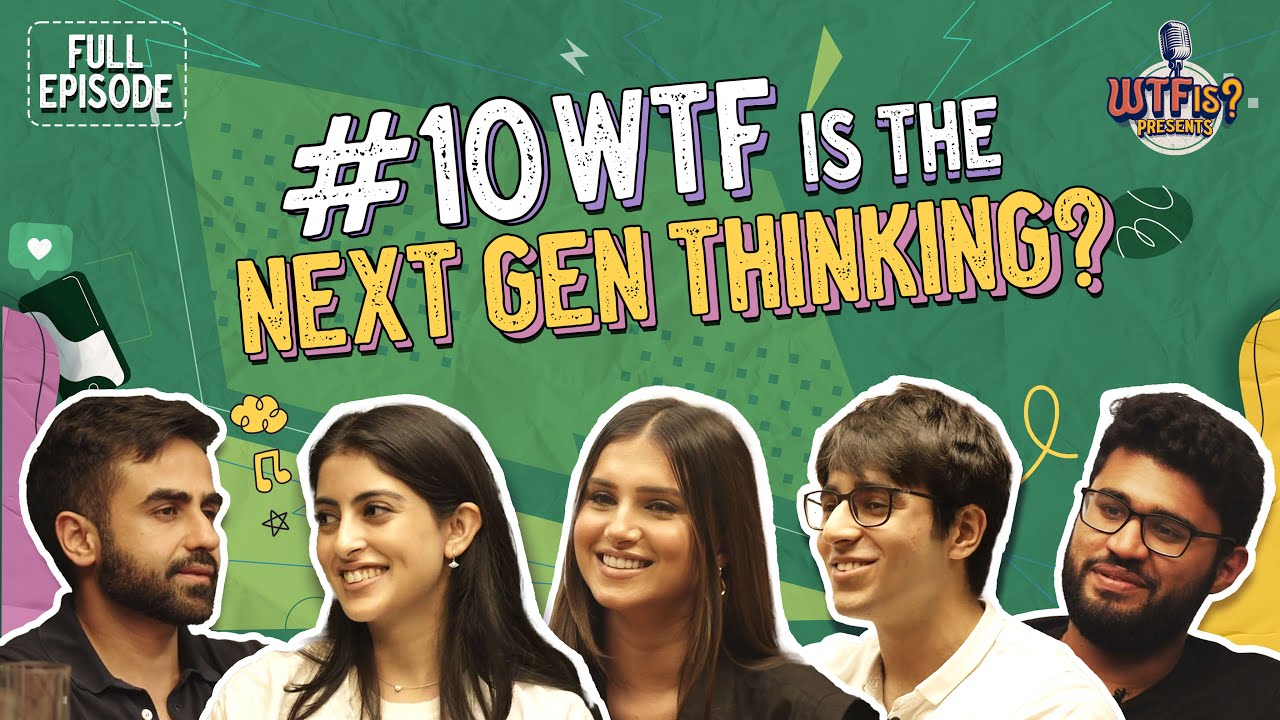
Ep #9 | WTF is Venture Capital? Ft. Nikhil, Nithin, Rajan A., Prashanth P. & Karthik R.
A panel of Indian VCs and founders explains how venture capital actually works, what separates winning founders, and why India is shifting from consumption to global product building.
Key takeaways
5 points- 1Power-law returns require swinging for outliers, not safe bets.
- 2Founder hunger and problem resonance outweigh pedigree.
- 3Consumer brands must combine digital reach with offline scale.
- 4India's real opportunity lies in global manufacturing and software exports.
- 5Recent IPO structures have often favored early investors over retail buyers.
Summary
Panel of prominent Indian investors and operators demystifies venture capital while mapping the traits, pitfalls and macro shifts that will shape the next decade of startups.
VC Structures and Returns
- Venture capital deploys institutional capital under the 2/20 model with 10-year fund lives; power law means 2-3% of companies generate 80% of returns (2:00-2:10).
- Angel investing succeeds only when investors add sector expertise beyond capital; 90% of angels lose money (40:13-50:16).
- Dry powder at Peak XV stands at $2.5B from its latest $2.8B fund (20:07-30:09).
Founder Traits and Red Flags
- Successful founders show deep problem resonance, rapid evolution and resilience through multiple near-death moments (1:50:37-2:00:40).
- Oversimplifying TAM or lacking self-awareness are instant deal-breakers (2:00:41-2:10:44).
India's Next Wave
- Consumer brands now follow digital-first, offline-second scaling; manufacturing and exports are the real $10T path via China+1 (1:20:28-1:40:33).
- Climate, upstream health and vertical AI dominate long-term opportunity (1:30:31-1:50:37).
Deep read
Executive Summary
This episode of Ep #9 from Nikhil Kamath’s channel captures a candid, multi-veteran discussion about the state and future of venture capital in India. The panel features entrepreneurs and investors who map the arc from seed to scale, offering a practitioner’s lens on sector opportunities, fund dynamics, founder traits, and the realities of capital markets in India. The conversation explores Rain Matter’s early-stage platform, Bloom’s growth and fund structure, Peak XV’s institutional approach, and Prashant/Axel’s energy and operational intensity. A central through-line is the recognition that India’s startup ecosystem is maturing but still needs durable, globally competitive product companies, strong manufacturing/export capabilities, and an ecosystem that supports long-run value creation rather than short-term hype. The dialogue also touches on macro-environmental concerns (global VC cycles, regulatory changes, and tax considerations) and ends with a philanthropic commitment that mirrors a broader industry ethos of contributing back to society. The episode blends stories, numbers, and practical heuristics to equip founders with a toolkit for evaluating sector opportunities, securing capital, and building resilient, scalable businesses over a decade or more.
00:00:00 - Introduction and session purpose
Major Topic
Session purpose & India VC landscape
- The host frames the aspiration: to help future founders learn through a candid, conversational discussion among experienced practitioners rather than a formal interview. Key idea: entrepreneurs should build businesses that solve problems they personally care about; the excitement around Indian entrepreneurship is at an all-time high; current rough VC capital into India is around $60B; the goal is to look 10 years out to identify billion-dollar opportunities. ⭐ HIGH PRIORITY
- The group aims to cover broad startup topics: sectors with tailwinds, sectors with headwinds, ease of fundraising, how VC differs from PE and angels, what went wrong in the last decade, and how to fix for the next decade.
> "this is not me interviewing you or moderating a conversation this is more five friends trying to have a conversation" (0:00)
00:02:00 - Opening framing and call for diverse perspectives
- The speakers are positioned as seasoned operators/investors sharing pragmatic lessons rather than hype. The goal is to produce concrete, actionable takeaways for founders starting in the next few years.
00:03:00 - Geographic and market context
- The panel underscores the fast-rising excitement around entrepreneurship in India and the importance of focusing on problems India has the potential to solve. They hint at the scale (10-year horizon) and the need to identify sectors that can deliver sizable opportunities in a decade.
00:04:00 - Sourcing and structure for the discussion
- The format is informal yet study-like: five participants sharing experience, traces of personal histories, and hands-on industry knowledge to help founders think through sector choices, fundraising dynamics, and startup operating realities. The aim is to produce a toolkit founders can apply as they start a company.
> "hi guys thank you everyone for coming here... this is not me interviewing you or moderating a conversation this is more five friends trying to have a conversation" (0:00)
00:07:00 - Preview of questions and topics
- They outline the core inquiries: which sectors in India have tailwinds vs headwinds; what sectors are easy or hard to raise money in; how VC compares to PE and angels; what went wrong in the last decade and how to fix it; and how to build for a future where India becomes a perennially attractive startup ecosystem.
00:10:04 - Rain Matter origin and personal stakes (Nathan speaks)
Subtopic
- Nathan introduces Rain Matter (investor/fund incubator model) and explains their APIs and startups built on Rain Matter (e.g., Small Quiz). They’ve invested in about 85 startups. The question posed: among those 85, how many survived, thrived, or failed? The emphasis is early-stage learning and iteration. This sets up a real-world frame about startup survival rates and the risk-return tradeoffs of early-stage investing.
> "we started this thing called as rain matter... 8085 startups" (0:10:04)
01:03:00 - Karthik’s background and Bloom story (Karthik speaks)
Subtopic
- Karthik shares his journey post-1999 in the US during the dot-com era, the tech boom/bust, and his return to India to explore venture investing. He traces his career arc through banking, media (Times of India), telecom, and tech, culminating in Bloom (Seed/early-stage VC). He explains the evolution of micro-VC models and the transition to early-stage investing in India, with Bloom's growth from a small fund to multi-fund vehicles.
- He describes Bloom’s fund size evolution: from ~₹100 crore to roughly $200–$300 million across primary funds, plus continuation/“continuity” vehicles to stay invested in top-performing companies. The rationale for continuity funds: to sustain investment in the best performers beyond their initial fund life.
> "so we have total Silicon Valley Super Angel fund model... we did our key work in the US and we saw that micro VC was erupting" (1:03:00)
01:40:00 - Rajan’s vantage on India, personal history, and VC mechanics (Rajan speaks)
Subtopic
- Rajan outlines his Sri Lankan-Indian upbringing, early career in the US (McKinsey, GM, Microsoft, Google), and his entry into Indian venture via angel investing. He highlights the long runway for entrepreneurship in India and the need for patient, long-horizon capital; he explains his role with Peak XV (early-stage growth/seed) and their fund structure (AUM, dry powder, and portfolio depth). He discusses the Indian venture ecosystem's maturation, the role of fund lifecycle (typically 10 years with extensions), and the concept of “continuity vehicles” or follow-on funds that allow continued support for the best performing companies.
- He emphasizes the idea that VC returns are powered by a few outsized winners (power-law dynamics), not by the average. He also discusses the idea that international LPs want India exposure but will allocate capital only if they trust the market and the fund manager's strategy.
> "we just raised what are called continuity Vehicles... almost 475 million primary and 150 continuation" (1:40:00)
02:20:00 - Prashant introduction and personal profile (Prashant speaks)
Subtopic
- Prashant (Axel veteran) is profiled as a high-energy, multi-tasking operator involved in multiple ventures with a focus on social impact (yipp charity) and operational excellence across portfolio. He elaborates on his long-standing partnership with Nitin and the energy required to manage a large portfolio and a variety of ventures. The conversation also weaves through the ecosystem’s realities in Bangalore/India and the importance of founder relationships, and the types of ventures they support.
> "Prashant... relentless man who has so much more energy..." (2:20:00)
02:50:00 - Angel vs VC vs PE basics (Nitin, Prashant, Rajan, Karthik)
Major Topic
- The group dives into the definitions and boundaries between Angel Investors, Venture Capital, and Private Equity:
- Angel: individuals investing their own money at very early stages; high risk, high variance; ~₹5 lakh to ₹2 crore check sizes; the ecosystem includes thousands of angels (India has thousands, hundreds of thousands in the US). The discussion notes that most angels do not invest professionally; the value add is often non-financial (talent networks, introductions). - VC: professional funds that raise money from LPs; invest in seed through growth; typical fund lifecycles are 7–10 years; existence of carry (20%) on profits after returning invested capital and fees; the discussion highlights the “two-and-a-half-decade” maturation of Indian VC with a handful of typically successful funds dominating returns; the concept of dry powder (unallocated capital awaiting deployment) is explained; and they discuss fund sizes and per-investment ticket sizes. - PE: private equity funds; longer-horizon, typical exits through IPO, strategic acquisition; generally larger ticket sizes; historically considered more conservative and later-stage than VC; in India, PE has a broader mandate across industries including non-tech, and has delivered more consistent cash-on-cash returns but with longer cycles.
- The talk also covers how LPs (Limited Partners) invest in VCs: due diligence, trust in India-specific capabilities, and the reality that many LPs invest in India through international funds; the role of reputation, track record, and house views on India’s market trajectory are foregrounded.
- They note that global macro shocks (e.g., FTX, public market declines) have affected global VC fundraising and valuations; India-specific downturns mirror global cycles, but the ecosystem remains in a growth phase and is gradually becoming more institutionalized.
> "Angel investing is your own capital; VC is institutional capital; PE is later-stage and broad" (2:40:00)
03:50:00 - The mechanics of venture capital (fund structure, carry, exits)
Subtopic
- The panel explains carry: VC managers often receive 20% carried interest on profits distributed after returning invested capital and fees. They discuss the “European waterfall” versus “American waterfall” for carry distribution; and the need to ensure that the fund returns capital plus fees before carry accrues. They note that this often means that carry is earned over a long horizon, and a fund’s early winners are what justify later back-end payoffs.
- They cover exits: IPOs, strategic acquisitions, and late-stage buyers. The capstone is that a successful VC’s performance hinges on a few outsized exits that drive the majority of returns.
> "you first return the capital and fees; you get carry on distribution" (3:50:00)
04:50:00 - The Indian LP market and fund-raising dynamics (Rajan, Nitin, Prashant)
Subtopic
- Discussion of how LPs in India and internationally evaluate funds: relationship-driven, reputation-driven, and performance-driven. They discuss the nuance that LPs often need to see India delivering concrete, repeatable exits and growth to commit more capital; the role of fund performance versus mere regional potential. They emphasize that LPs invest in India as a macro bet, but will still require a strong track record from fund managers before committing more capital.
- The group notes tax considerations and cross-border investments: many global LPs avoid Indian taxes by using fund vehicles outside India; Indian tax treatment for carried interest and fund fees remains a consideration for domestic managers.
> "LPs invest in India, and within India they choose fund managers; they need to see returns to deploy more" (4:50:00)
05:40:00 - Sector focus, market sizing, and the consumer/tech opportunity in India (Nitin, Rajan, Karthik)
Major Topic
- They shift to sectoral discussion and market sizing: India’s consumer market, manufacturing, and export potential. They debate how to size a sector, with emphasis on the fact that India’s 65% of GDP is consumption-related and that a significant portion of this is throughput through distribution and retail.
- They discuss the omnichannel model: combining online and offline channels to scale brands in India; the role of B2B platforms and ONDC (Open Network for Digital Commerce) in transforming distribution economics and reducing CAC for multi-brand retailers and consumer brands.
- Several anecdotes about consumer brands (Bluestone, Mamaearth, Freshworks, etc.) illustrate how brands achieve scale by combining online discovery with offline distribution and by building or partnering with manufacturing capability in India. They stress the importance of having a unique insight into customer needs and focusing on product quality as a differentiator rather than merely channel expansion.
- They discuss the importance of manufacturing local value chains (PLI schemes, etc.) to improve India’s export competitiveness and reduce dependency on imports for components and finished goods.
> "65 percent of our GDP is consumption; 800-900 billion export market... India can build world-class products and export them" (5:40:00)
06:30:00 - The omnichannel and manufacturing strategy debate
Subtopic
- The panel debates the relative value of platform versus marketplace versus vertically integrated brands. They discuss the risk and reward of building for export markets from Day One versus focusing on domestic scale first. They examine how ONDC may alter distribution economics and the need for distinct product value propositions and brand strength to win.
- They illustrate through case studies the necessity of product superiority as a differentiator; patriotism is framed not as a sole driver but as a signal of preference for quality, reliability, and local relevance. They emphasize that the best Indian brands win on product excellence and value proposition rather than purely nationalist sentiment.
> "the most important thing is a unique insight about what customers want" (6:30:00)
07:50:00 - Sector opportunities—AI, climate, health, education, and skilling
Major Topic
- The discussion surfaces several growth vectors across climate tech, health, AI, and education/skilling. They emphasize long-term trends and the risk of chasing short-term fads. They propose focusing on AI as a macro enabler with a strong potential for verticals (healthcare, education, enterprise software, developer tooling) where AI can unlock efficiency, personalization, and novel business models.
- Climate tech is framed as an aspirational mega-trend with opportunities in materials, energy transition, and sustainable manufacturing. They highlight the need for durable, scalable products that address climate challenges and enable new value chains (e.g., recyclable materials, carbon credits with farmer income uplift, etc.). The group underscores India’s potential to leverage its manufacturing capabilities to become a global leader in climate-affecting technologies and green supply chains.
- They discuss the importance of “upskilling” and employment enablement as a pathway to long-run societal and economic growth. A concrete example is a company that trains phlebotomists and ties certification to employability—a model that scales cost-effectively in India and addresses workforce gaps in healthcare.
> "AI is the number one trend right now; vertical use cases in healthcare, education, etc., will be super interesting" (7:50:00)
08:50:00 - Founders’ traits and what makes a startup investable (Rajan, Karthik, Nitin, Prashant)
Subtopic
- The panel discusses the traits that tend to correlate with startup success. Core themes include:
- Founders with authentic, long-term alignment to the problem; a deep personal purpose that sustains the startup through 10+ year journeys. - A strong, single founder who can drive vision (CEO/lead) with complementary co-founders or key senior leaders (e.g., a strong CTO for tech-led ventures). - Willingness to evolve—founders who adapt their strategy and beliefs to changing market realities while preserving core values like customer obsession and integrity. - The value of founder humility and willingness to learn, plus the ability to recruit and work with top-tier tech talent (a strong CTO is often critical). - The importance of a founder’s ability to network effectively and secure meetings and partnerships; the idea that “storytelling and connections” often unlock opportunities and capital.
> "founders who truly relate to the problem they are solving; the mission keeps them going" (8:50:00)
09:50:00 - Founder psychology: resilience, agility, authenticity
Major Topic
- They discuss founder resilience (the ability to endure near-death moments such as cash crunches, cofounder disputes, or competitive pressures) and agility (the ability to pivot, reallocate resources, and reframe the business to fit a changing market). They emphasize authenticity—founders should acknowledge their own strengths and weaknesses rather than pretend to be perfect entrepreneurs; genuine self-awareness and openness to feedback are valuable signals to investors.
- The panel debates hard work vs. intelligent work: hard work is necessary but not sufficient; the way founders deploy their effort, their focus on customer value, and their ability to execute with a team are what ultimately drive outcomes.
> "resilience and agility; write your values in ink and adapt your strategy as needed" (9:50:00)
10:50:00 - The closing charity pledge and audience engagement
Subtopic
- The show ends with a ritual of charity pledges from the guests. They discuss various charities focused on climate/environment, child health/education, and social impact. They encourage the audience to vote on the charity receiving the proceeds of the episode’s donation drive. This is framed as a way to contribute back to society and bridge the investment community with social outcomes.
> "we commit to donate to a charity; audience will vote on the recipient" (10:50:00)
11:50:00 - Wrap-up and sign-off
Subtopic
- The host thanks the participants and invites viewer feedback, likes, and subscriptions. The closing credits encourage engagement and set expectations for future episodes.
> "thank you for watching" (11:50:00)
12:40:00 - How to read the episode and actionable takeaways for founders
Subtopic
- The discussion is dense with practical takeaways: hierarchy of capital (angels → VCs → PE), the power-law nature of returns, the need for sector selection anchored by macro trends but driven by founder capability, the importance of a world-class product for global scaling, and the critical role of manufacturing and export readiness for India’s growth. Founders should internalize the idea that the Indian market is large but complex; success hinges on product-market fit plus a scalable distribution and manufacturing strategy that can compete globally.
> "If you’re going to start a company in India, build for the globe from Day Zero; you must be world-class in product and execution" (12:40:00)
13:50:00 - Recap on sector select and action steps for founders
Subtopic
- The panel’s consensus leans toward choosing sectors with durable, long-term secular growth (AI tooling, climate tech, health/ups-kills, education, manufacturing) and a realistic plan to scale internationally. They encourage founders to pursue deep tech and manufacturing where India has a unique cost/skill advantage and to pursue early global consumer brands where the product quality wins over price alone.
> "the first unicorns in deep tech/manufacturing will catalyze the ecosystem; posters help attract capital" (13:50:00)
14:50:00 - Final thoughts and thanks
Subtopic
- The guests summarize the core message: build with conviction, aim for durable impact and long horizon, balance risk with a plausible path to scale, and remember that capital will back the best founders with strong insights into customer needs and execution capability.
> "this is a conversation between friends with a shared belief in the India opportunity" (14:50:00)
15:15:00 - Resources Mentioned
Resources Mentioned
- Rain Matter (venture incubator/angel network)
- Rain Matter Health
- Rain Matter Climate
- Rain Matter Foundation
- Bloom (Bloom Ventures)
- Rain Matter’s portfolio experiments (e.g., Small Quiz)
- Indian Angel Network (IAN)
- Times of India (Times/Media background for Rajan)
- Lehman Brothers' crisis as a historical reference point
- Peak XV (Peak 15) – Indian VC firm with ~₹2-3B USD AUM, dry powder ~₹2.5B; fund structure includes multiple funds and continuation vehicles
- Axel (Axel) – a large VC/technology investment firm
- ONDC (Open Network for Digital Commerce)
- LEGO of public markets vs private markets (conceptual)
- SPAC (Special Purpose Acquisition Company) – a structure for SPACs discussed in the context of exits
- PLI (Production-Linked Incentive) and Indian manufacturing policy
- ONDC, Namayatri, MagicPin (as examples discussed in the context of distribution and online/offline interplay)
- Bhargava’s (Ayurveda Experience) – an example of Indian consumer growth abroad
- Act Environment – a charity focused on air, water, waste, land use
- Smile Foundation – health and education for children
- Trees (Rain Matter Foundation) – climate/action with farmer livelihoods
Resources Mentioned (organization names, funds, programs, and platforms)
- Rain Matter
- Rain Matter Health
- Rain Matter Climate
- Rain Matter Foundation
- Bloom Ventures
- Indian Angel Network (IAN)
- Peak XV (Peak 15)
- Axel (Axel)
- ONDC (Open Network for Digital Commerce)
- Namayatri (ride platform example)
- MagicPin (ONDC-affiliate distribution example)
- Kiran from Biocon (IPO example; discussion about IPO dynamics)
- ACT Environment (climate/environment charity)
- Smile Foundation
- Trees (Rain Matter Foundation initiative)
- Freshworks, Flipkart, BookMyShow (portfolio reference points)
- Bluestone, Mamaearth, Lenskart, Nykaa (examples of consumer brands discussed)
- Rain Matter (Small Quiz, 8085 startups)
- LEHMAN CRISIS as macro context for venture cycles
Glossary / Definitions (first appearance)
- VC: Venture Capital, professional funds investing in early to growth-stage companies with a high-risk, high-return model.
- PE: Private Equity, typically later-stage, larger-ticket investments with a focus on optimizing mature businesses and potential exits.
- Angel Investor: An individual investor using personal capital to fund very early-stage startups; often offers mentorship and networks, not a formal fund.
- Dry Powder: Unallocated capital held by funds that is ready to be deployed when opportunities arise.
- AIF: Alternative Investment Fund, Indian regulatory category for pooled investments; Cat 1, Cat 2, Cat 3 denote different risk/asset class rules.
- Cat 1/2/3: Subcategories under the Indian AIF framework; Cat 1 and Cat 2 mainly deal with venture and private equity investments in equities, debt, or other securities; Cat 3 often for listed securities; used to classify allowed investment strategies.
- Carry (Carried Interest): The share of profits that fund managers receive as a performance fee after limited partners get their capital back.
- Ops/Runway: Startup operating liquidity duration; runway is the time a startup can operate before needing more capital.
- PLI (Production-Linked Incentive): Indian government policy to spur manufacturing via subsidies/price incentives to boost domestic manufacturing.
- ONDC (Open Network for Digital Commerce): India's government-backed platform to democratize e-commerce by enabling businesses to sell via open networks.
- D2C / D2B; SKU: Direct-to-Consumer branding; retail and distribution dynamics.
- IPO: Initial Public Offering, when a private company lists shares on a public market.
- OFS: Offer for Sale, a mechanism for existing shareholders to sell their stake in a company through a public market listing.
Quotes (verbatim excerpts)
- "this is not me interviewing you or moderating a conversation this is more five friends trying to have a conversation" — 00:00:00, Speaker: Nikhil Kamath
- "the excitement in India is higher than it's ever been" — 00:00:00, Speaker: Nikhil Kamath
- "we started this thing called as rain matter... which started off as a fund incubator" — 00:10:04, Speaker: Nathan
- "I spent 12 years... how big is Bloom now" — 01:03:00, Speaker: Karthik
- "dry powder is money that we haven't invested yet; investable capital" — 01:40:00, Speaker: Karthik
- "65 percent is consumption; 65% of GDP is consumption" — 05:40:00, Speaker: Nitin / Group
- "the highest returns come from 2% of the portfolio" — 03:50:00, Speaker: Rajan / Panel
- "you first return the capital and fees; carry accrues on distribution" — 03:50:00, Speaker: Rajan / Panel
- "ONDC will have significant impact over the medium term" — 06:30:00, Speaker: Nitin / Group
- "AI is the number one trend right now" — 07:50:00, Speaker: Nitin / Group
- "founders who truly relate to the problem... mission keeps them going" — 08:50:00, Speaker: Rajan
- "write your values in ink and your strategy; be agile" — 09:50:00, Speaker: Prashant / Group
- "the most important thing is a unique insight about what customers want" — 06:30:00, Speaker: Nitin / Group
- "the 25 Lakhs to act environment" — 10:50:00, Speaker: Collective
Executive summary
- The episode functions as a flagship, long-form dialogue intended to distill practical wisdom about starting and scaling Indian startups in a post-VC-boom era. The panelists—Nikhil Kamath’s show guests—cover a broad spectrum: Rain Matter’s early-stage playbook; Karthik and Bloom’s fund-structure and long-horizon approach; Rajan Anandan and Peak XV’s venture economics and the power-law reality of VC returns; Prashant (Axel)’s operational energy, and Nitin’s broad market experience at Surge and Google/Peak15 interactions. The central thesis is that India’s startup ecosystem is growing more institutionalized and capable of producing global-scale product companies if founders are deeply aligned with meaningful problems, maintain authenticity and resilience, and execute with a world-class product, coupled with a scalable go-to-market and manufacturing/export strategy.
- The conversations emphasize: (1) the distinction and relationship between angels, VCs, and PE; (2) the structure and lifecycles of VC funds (carried interest, dry powder, exit dynamics, and fund-performance); (3) the sector-level opportunities in India (consumption-led growth, omnichannel distribution, and the importance of product excellence and manufacturing); (4) the macro trend view toward AI, climate tech, health, and skilling; (5) founder traits associated with success (resilience, adaptability, founder-market fit, and the ability to recruit and lead high-performing teams); (6) ethical and social considerations including charity contributions and the broader impact of VC on society. The episode concludes with a call to action for founders to pursue durable, globally scalable products, invest in human capital, and engage responsibly with the ecosystem.
Key takeaways
- India’s startup ecosystem is maturing toward institutional capital; expect continued growth but with more scrutiny from LPs.
- The power-law reality means a small share of portfolio companies deliver outsized returns; plan for follow-on funding to support the best performers.
- Angel investing remains high-risk; the value to founders often lies in networks and advisory capital beyond just money.
- Sector bets should consider long-term secular trends and India’s strengths in manufacturing, supply chains, and consumer markets; global exports are a realistic growth engine.
- Online/offline (omni-channel) strategies and the emergence of ONDC can democratize distribution, but product excellence remains essential for sustained growth.
- AI and climate tech are top near-term bets; breakthroughs in tooling, vertical applications, and manufacturing efficiencies are likely to yield the biggest impact.
- Founder traits that correlate with success: deep mission alignment, resilience through near-death moments, willingness to adapt and learn, and the ability to build and lead a complementary team (strong CTO, etc.).
- The fundraising landscape stretches across angels, seed/VC, and private equity; LPs’ willingness to back India is increasingly contingent on demonstrable local capabilities and exit track records.
- A practical operating framework for founders: identify a big but plausible market, insist on a unique customer insight, ensure product excellence, build a scalable go-to-market/distribution strategy, and maintain a long-term horizon with the stamina to ride cycles.
Action items
- For aspiring founders: map out a 10-year opportunity with a strong product thesis; identify 3–5 concentric markets where you can become a global player from Day One.
- Build a robust founder-market fit: articulate why you personally care about the problem and how your background uniquely positions you to solve it.
- Develop a clean, scalable distribution plan that combines online/offline channels; assess ONDC-enabled opportunities for distribution cost advantages.
- Prioritize product excellence and manufacturing capabilities that enable export potential; consider government incentive programs (like PLI) early in your plan.
- Seek early mentors/co-founders with complementary strengths (e.g., CTOs for tech-heavy ventures; distribution experts for consumer brands).
- When presenting to LPs/VCs, emphasize a conservative yet ambitious multi-year plan with explicit follow-on funding milestones and clear exit pathways.
- For angels: focus on sectors where you can add non-monetary value (network access, domain expertise, hiring leverage) rather than only writing checks.
- If you’re aiming for climate/AI/health skilling opportunities, build a long-term capability plan for workforce training and scalable deployment models.
- Consider charity or impact commitments; use social investments to bolster ecosystem credibility and leverage.
Mental models
- Power law / Pareto principle in VC: a tiny fraction of investments drive the majority of returns; expect ongoing asymmetry.
- VC fund lifecycle and carry mechanics: capital return first, then management fees, then carry; exits determine the carry realization.
- Market sizing framework: 1) total addressable market, 2) serviceable obtainable market, 3) addressable markets in adjacent geographies.
- Omni-channel play: the combination of online and offline channels reduces CAC over time; a strong brand with product excellence enables sustainable margin growth.
- Founder/CEO as a strategic asset: one alpha founder who can drive the vision, with a strong CTO or co-founders to complement capabilities.
- Resilience as a differentiator: entrepreneurs who persevere through downturns and adapt strategy tend to emerge stronger; stability and consistent values attract partners and teams.
Topics
- Venture Capital in India
- Angel Investing vs VC vs PE
- Indian LP Landscape
- Sector Opportunities: AI, Climate, Health, Education, Manufacturing
- Omnichannel & Distribution (ONDC)
- Indian Manufacturing & PLI
- Founder Traits & Team Dynamics
- Exit Mechanics & Carry Structures
- Social Impact & Philanthropy in VC
Resources Mentioned
- Rain Matter (fund incubator) / Rain Matter Health / Rain Matter Climate / Rain Matter Foundation
- Bloom Ventures (Karthik’s firm)
- Indian Angel Network (IAN)
- Peak XV / Peak 15 (Rajan’s fund)
- Axel (Axel) / Axel India
- ONDC (Open Network for Digital Commerce)
- Namayatri (mobility) / MagicPin (retail/offline integration)
- Biocon (Kiran’s IPO context) and IPO dynamics
- ONDC, ONDC-enabled distribution pilots
- PLI (Production-Linked Incentive) schemes for Indian manufacturing
- SPAC (Special Purpose Acquisition Company) concepts
- Freshworks, Flipkart, BookMyShow, Bluestone, Mamaearth, Lenskart, Nykaa (portfolio-market examples)
- Act Environment, Smile Foundation, Trees (climate/charity organizations)
- Rain Matter portfolio examples (Small Quiz, 8085 startups)
- Lehman crisis as macro reference point for market cycles
Glossary (term, definition)
- Angel Investor: An individual investor using personal funds to invest in very early-stage startups, often providing mentorship and networks.
- Venture Capital (VC): Professionally managed pooled funds investing in high-risk, high-potential startups across seed to growth stages.
- Private Equity (PE): Institutional capital investing in relatively mature companies, often with governance changes and strategic exits.
- Dry Powder: Unallocated capital held by funds, ready to be deployed when opportunities arise.
- Carry (Carried Interest): The share of profits (commonly ~20%) paid to fund managers after returning investor capital and fees.
- AIF (Alternative Investment Fund): Indian regulatory category for pooled investment funds; Cat 1/2/3 denote different investment restrictions.
- Cat 1 / Cat 2 / Cat 3: Subcategories under the Indian AIF framework; Cat 1 and Cat 2 cover venture/private equity; Cat 3 can include listed securities.
- ONDC: Open Network for Digital Commerce; a public platform aimed at democratizing e-commerce in India.
- PLI: Production-Linked Incentive; government subsidies to spur domestic manufacturing.
- IPO: Initial Public Offering; first sale of a company’s stock to the public.
- SPAC: Special Purpose Acquisition Company; a shell company created to merge with a private firm and take it public.
- D2C: Direct-to-Consumer; brands selling directly to consumers, bypassing traditional retailers.
Quotes (text, timestamp, speaker)
- {text: "this is not me interviewing you or moderating a conversation this is more five friends trying to have a conversation", timestamp: "00:00:00", speaker: "Nikhil Kamath"}
- {text: "the excitement in India is higher than it's ever been", timestamp: "00:00:00", speaker: "Nikhil Kamath"}
- {text: "we started this thing called as rain matter... 8085 startups", timestamp: "00:10:04", speaker: "Nathan"}
- {text: "how big is Bloom now and how many companies have you done in a fourth fund", timestamp: "01:03:00", speaker: "Karthik"}
- {text: "you first return the capital and fees; carry comes on distribution", timestamp: "03:50:00", speaker: "Rajan"}
- {text: "AI is the number one trend right now; vertical use cases in health, education, etc. will be super interesting", timestamp: "07:50:00", speaker: "Nitin"}
- {text: "the most important thing is a unique insight about what customers want", timestamp: "06:30:00", speaker: "Nitin"}
- {text: "founders who truly relate to the problem... mission keeps them going", timestamp: "08:50:00", speaker: "Rajan"}
- {text: "we commit to donate to a charity; audience will vote on the recipient", timestamp: "10:50:00", speaker: "Host"}
Topics Tags
- Venture Capital in India
- Angel Investing
- Private Equity
- Indian Startups
- AI & Deep Tech
- Climate Tech
- Health & Education Skilling
- Omnichannel & ONDC
- Indian Manufacturing & PLI
- Founder Traits & Team Dynamics
- Exit & Carry Structures
Action Items
- If you're starting a company in India, validate a long-horizon opportunity with global scalability from Day 1.
- Develop a strong founder-market fit narrative and assemble a complementary leadership team (CEO + CTO) early.
- Design a go-to-market strategy that blends online and offline distribution and leverages ONDC when feasible.
- Assess manufacturing and export potential early; explore government incentives (PLI) and local production capabilities.
- Seek mentors and strategic angels who can add value beyond money (networks, hiring, distribution).
- For fundraising: prepare a multi-stage plan with clear follow-on milestones and exit strategies to satisfy LPs.
- Consider climate/AI/health/education as macro themes; ensure your product solves a tangible problem with scalable unit economics.
- In negotiations, understand carry structures and fund lifecycles; align incentives with long-run company performance.
Mental Models
Glossary
- Dry Powder
- Unallocated capital held by funds that is ready to be deployed when opportunities arise.
- AIF
- Alternative Investment Fund; Indian regulatory category for pooled investments, with subcategories Cat 1/2/3 defining allowed strategies.
- Cat 1 / Cat 2 / Cat 3
- Subcategories under the Indian AIF framework; Cat 1/2 primarily for venture/PE; Cat 3 often related to listed securities and more liquid strategies.
- Carry / Carried Interest
- A share (commonly 20%) of profits paid to fund managers after investors get their capital back.
- ONDC
- Open Network for Digital Commerce; India's platform to democratize online commerce by enabling broad participation.
- PLI
- Production-Linked Incentive; government subsidies to support domestic manufacturing and export growth.
Notable Quotes
“this is not me interviewing you or moderating a conversation this is more five friends trying to have a conversation”
“the excitement in India is higher than it's ever been”
“we started this thing called as rain matter... 8085 startups”
“how big is Bloom now and how many companies have you done in a fourth fund”
“you first return the capital and fees; carry comes on distribution”
“AI is the number one trend right now; vertical use cases in health, education, etc., will be super interesting”
“the most important thing is a unique insight about what customers want”
“founders who truly relate to the problem... mission keeps them going”
“we commit to donate to a charity; audience will vote on the recipient”
Topics
More from WTF is with Nikhil Kamath
See all