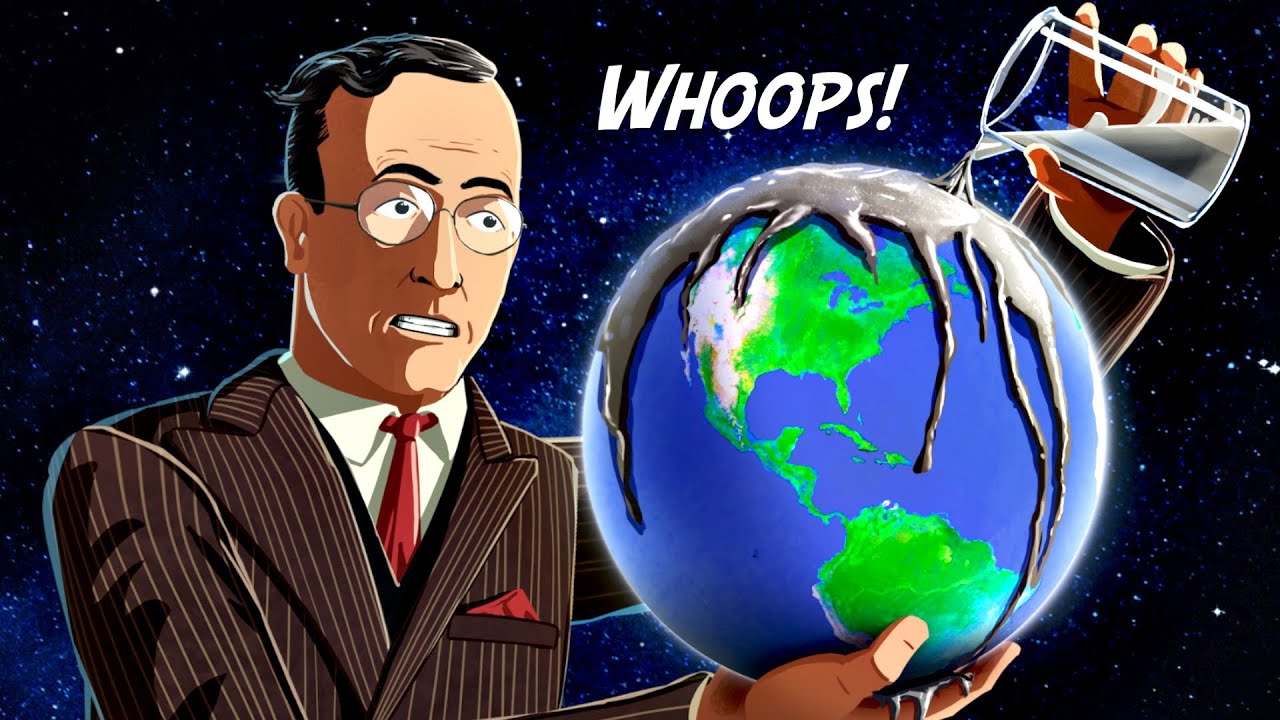
The Only Time In History That Water Was Safer Than Land
Late Permian land became deadlier than oceans due to gorgonopsid and therocephalian apex predators until the Great Dying reset Earth.
Key takeaways
7 points- 1Land predators exceeded marine threats only during the Late Permian.
- 2Gorgonopsids used skull size and grappling over bite force.
- 3Some therocephalians may have delivered venom.
- 4Herbivores countered with armor or burrowing.
- 5No large aerial predators existed in the Permian skies.
- 6Siberian Traps volcanism caused rapid global warming and ocean acidification.
- 7The Great Dying remains Earth's most severe extinction event.
Summary
In the Late Permian, land predators grew so dominant that water became the safer refuge until the Great Dying ended the nightmare.
Core Concept
- Nature's usual pattern (scarier oceans) reversed when gorgonopsids and therocephalians ruled Pangea (0:00-0:45).
- No large flying predators existed, unlike the later Mesozoic (18:28-19:21).
Land Predators
- Rubidgea had skulls over 15% of body length built for grappling despite weak bite force (10:06-11:27).
- Moschorhinus pinned prey with forelimbs before fatal bites; some therocephalians may have used venom (12:18-13:35).
- Inostrancevia and Mega-Whaitsia ranked among Earth's largest land carnivores (13:35-14:25).
Prey Adaptations
- Scutosaurus evolved heavy armor and dense bones as slow-moving tanks (16:30-18:28).
- Lystrosaurus survived by burrowing (16:30-18:28).
The Great Dying
- Siberian Traps eruptions caused extreme warming, ocean acidification, and ozone collapse 252 mya (20:09-22:20).
- 83% of genera vanished, far exceeding the dinosaur extinction (20:09-22:20).
Deep read
Executive Summary
The video argues that water has not always been the deadlier arena for life on Earth; during a narrow window in the late Permian (the Linan epoch), aquatic life enjoyed relative safety compared with the rapidly shifting land-based predator regime. After an era of changing continental configurations (Pangia) and a mammoth ocean (Panthalassa), an aggressive land predator guild—most notably gorgonopsids and therocephalians—emerged, making terrestrial life perilous. The Capitanian extinction and the Siberian Traps eruptions catalyzed the end-Permian Great Dying, profoundly reshaping both land and sea ecosystems and setting the stage for future biological trajectories. The video blends fossil taxa (like Inos transavia and rubidia atrox), anatomy (saber teeth, skull armor), and climatologic/oceanographic context to explain why water could be safer than land at certain times, and why that safety evaporated as the planet moved toward the end of the Permian.
The core narrative frames a paradox: oceans were long portrayed as dangerous arenas, yet in Linan they offered relative refuge, while land dwellers faced a succession of formidable predators. The late Permian’s predatory landscape—dominated by gorgonopsids across many continents—drove terrestrial risk up, while marine life was battered by extinctions that reshaped oceanic communities. With the Great Dying, ecosystems on both land and sea were irrevocably altered, changing the trajectory of life on Earth for millions of years to come. The video uses vivid taxa descriptions (e.g., Inos transavia as the largest gorgonopsid, rubidia atrox as a giant African predator) and large-scale geological events (Siberian Traps, Pangia, Panthalassa) to ground this narrative in concrete, study-grade details.
00:00:00Major Topic
SubtopicNature’s Unspoken Rule And The Period That Broke It
Speaker: ExtinctZoo
- There seems to be an unspoken rule in nature where life in the ocean and seas must always be far scarier than life on land. This is presented as a historical pattern, not just a modern impression, and the video argues that there was a finite window in Earth’s past when survival chances were actually better in the water than on land.
- The host frames this idea as a paradox: oceans host mega-predators and ancient dangers, yet there was a period before dinosaurs when water offered relative safety compared to land. This sets up the central claim of the video: water can be a safer refuge even when oceans look terrifying.
- The Linan (late Permian) epoch is introduced as the time frame when life in the water could outperform land dwellers in terms of survival, contrasting sharply with the general rule that water is dangerous and land is safer. The Linan is described as an era when Earth’s conditions were almost unrecognizable, including shorter days (around 22 hours) due to the Moon being closer to Earth.
> Notable quote: > "there seems to be an unspoken rule in nature where life in the ocean and seas must always be far scarier than life on land" (0:00)
- Geological superstructure is described: Pangia as the dominant landmass, with Africa, the Americas, Antarctica, India, Australia, and parts of Europe all connected; landmasses formed two islands around Siberia-North China and Southeast Asia, with Turkey, Iran, and Tibet as island-like landmasses in a large oceanic system. Panthalassa, the vast ocean to the west of Pangia, covered more than 60% of Earth’s surface—twice the size of today’s Pacific.
- The video emphasizes the scale of Panthalassa and its potential for danger, but notes that even in this vast ocean, some marine life persisted in ways that influenced future life trajectories. The ocean ecosystem was not uniformly rich in giant predators, but the water’s vastness and climatic context shaped marine life’s evolution.
- The Capitanian mass extinction (a precursor to the Late Permian crisis) is introduced as a marine extinction event that contributed to the decline of marine life and reshaped predator–prey dynamics on land and water.
- The stage is set for the broader argument: while water was not universally safe, the Linan epoch witnessed conditions where aquatic life could outcompete or outlast terrestrial life in certain ways, even as land was ruled by new and dangerous predators.
00:45SubtopicGeography & Oceanography
- Pangia’s configuration led to two major oceans around it: Panthalassa (the vast global ocean) and the smaller Tethys-like seas on the periphery described as the Paleo Tethys in the narrative. Panthalassa dwarfed other oceans and shaped climate, weather, circulation, and life distribution.
- Panthalassa is described as an ocean bigger than the current Pacific Ocean by about two times; this immense sea would have presented both opportunities and challenges for marine life, including larval dispersal, predator ranges, and nutrient flows.
- The video emphasizes geographic isolation and mass distribution effects: landmasses were configured as “islands” and “subcontinents,” which impacted the evolution of both land and sea animals through endemism and competition.
02:15SubtopicWhat Lived In The Oceans & Seas
- The oceans were not teeming with the colossal megafauna that later defined some other periods; there were sharks and other marine arthropods, but many groups were smaller or in decline after prior Paleozoic events.
- Helicoprion, an 8-meter-long shark with a dramatically unusual jaw structure (teeth arranged on the bottom jaw in a whorl-like cluster), is described as a Permian poster child for marine megafauna; however, by the Linan, this megatoothed lineage had largely died out.
- Contemporary sharks like Sphenacanthids and Hibdons (and others in the same broad group) were present but not as gigantically dominant as the later Mesozoic giants. Their sizes were typically under 2 meters and more specialized for soft prey such as squids rather than hard prey.
- The uids or scorpions (arthropods) remained present but were under stress; they had not fully recovered from the Devonian mass extinction and were a remnant group rather than apex predators.
- The Capitanian extinction left marine life depleted, which contributed to a less dangerous but still precarious ocean environment. The oceans were not dominated by huge predators during Linan, but significant extinctions and shifts occurred.
03:56SubtopicWhat Caused Life In The Water To Be So Unscary?
- The Capitanian extinction event is framed as a key driver behind water’s relative safety in this period: terrestrial life suffered, while marine life was being decimated, especially among trilobites and early ammonoids.
- The aquatic environment’s relative stability during this time is explained as a function of multiple interacting drivers: prior extinction scars, climate, ocean chemistry, and ecological vacancies in marine ecosystems that would later be filled by different lineages.
- The narrative emphasizes that water would not remain safe indefinitely; the Great Dying later would dramatically alter both land and sea life, but the Linan epoch still represented a window where aquatic life could outlast many land-dwelling competitors.
04:35SubtopicThe Opposite Story On Land & Earth’s Old Rulers
- On land, the Permian’s old rulers, the dinocephalians (large-bodied therapsids) were waning. Their demise opened ecological space for new predatory groups to take over.
- The gorgonopsids, a group of saber-toothed predator therapsids, rose to prominence after the dinocephalians declined. They are highlighted as major land predators of the late Permian, filling the role of apex predators in many ecosystems.
- Gorgonopsids are named after Greek mythological gorgons due to their fearsome skull features and saber-like teeth. They are not mammals; they are therapsids, a group more closely related to mammals than reptiles but not mammals themselves.
05:11SubtopicEarth’s Original Sabre-Tooths
- Gorgonopsids evolved to have deep-set teeth, parasagittal (side-to-side) gates, long narrow skulls, and razor-sharp elongated canines. They are one of the earliest saber-tooth predators, a trait later famous in Smilodon and other mammalian lineages.
- These predators started small (roughly a foot long in the earlier stages) and grew larger through the late Permian, culminating in very large forms in the late Permian.
- The Inos transavia is highlighted as the largest gorgonopsid on record, potentially exceeding 11 feet (3.5 meters) in length and weighing over 1,000 pounds (about 453 kg), with robust limbs for speed and agility. Its large post-canine teeth and large upper canines (15 cm / 6 inches) would be devastating weapons.
- Two schools of hunting strategies are proposed for Inos transavia: a bite-and-retreat style (similar to Smilodon’s neck bites) or an ambush approach aimed at causing rapid blood loss. The exact hunting method remains debated.
06:30SubtopicThe Largest Predator
- Inos transavia is described as a widespread predator across Africa, Asia, and European Russia, adapting to various biomes such as warm floodplains and cold deserts, occasionally in shallow lakes or sparse forests.
- Some paleontologists speculate that it had fur due to its life in cold desert environments, though this is not confirmed.
08:45SubtopicPermian Russia Was A Problem
- Russia (part of the European-Russian Permian ecosystem) harbored a large suite of gorgonopsids that dominated many ecosystems, making land a dangerous place for herbivores and smaller predators alike.
- The late Permian Russian ecosystems are described as some of the most dangerous for herbivores, given the presence of multiple large predators and competing therapsid groups.
09:18SubtopicThe Giant Gorgonopsids That Ruled Africa
- In Africa, a subfamily of giant gorgonopsids evolved independently, including the rubidia group. These giants were robust, with thick skulls and heavily serrated teeth designed for slicing flesh.
- Rubidia atrox, a species from South Africa/Tanzania, could approach 10 feet (3 meters) in length. They coexisted with other large therapsids and likely shaped local ecosystems through predation pressure and niche partitioning.
- Even though Inos transavia was the largest single gorgonopsid, the rubidia group represented a large, diverse, and formidable predator clade across Africa.
11:27SubtopicThe Arch Nemesis - Therocephalians
- Therocephalians emerged as another predatory group during the Middle Permian and persisted into the Late Permian. They are different from gorgonopsids in skull structure, dentition, body plan, and ecological strategies.
- Some therapsids within this group could reach jaguar-like sizes and were diverse in their hunting techniques, with the potential of venomous species (like Ichibops and Yukkersia) among some lineages, which, if accurate, would mark early tetrapods evolving venom.
- The theos falans appear as an evolutionary trend that included a broad range of predators with distinctive skulls and tooth structures. They were diverse in anatomy, some becoming semi-aquatic, others fully terrestrial, and some with saber-like teeth similar to gorgonopsids.
12:18SubtopicFirst Animals To Evolve Venom
- Among the Theos falans, some lineages may have evolved venom delivery systems, potentially among the dog-sized Ichibops and Yukkersia, which would mark an early tetrapod venom evolution. However, this claim remains debated among paleontologists and is not universally accepted.
12:50SubtopicJaguar Sized Predator With A Lion Sized Head
- The moscosarinus (the Moscar Rinus) is introduced as a Jaguar-sized predator with a lion-sized head. It is described as a top late-Permian predator with a powerful bite and forelimbs used to pin prey before driving in with teeth and jaws.
- Fossil records suggest a robust forelimb-driven hunting style, with a formidable bite that complemented its large skull size and conical teeth.
13:35SubtopicRunner Up For Largest Land Carnivore
- The Megachoron species or related taxa are implied as other large predators that rival the moscar Rinus in size, though not as dominant in the ecosystem as Moscar Rinus or gorgonopsids.
14:25SubtopicOther Late Permian Carnivores
- Beyond gorgonopsids and the Theos falans, a range of other predators existed, including crocodile-like prototypes (protosukia) and armored Cronosukia-like reptiles, which added diversity to late Permian predation.
- Protosuids were slender reptiles with large needle-like teeth; Cronosukia had extensive armor on their backs and variable habitat preferences (fully terrestrial to semi-aquatic).
- These predators supplemented the predator guild, shaping trophic dynamics and predator-prey interactions across continents.
15:20SubtopicAmphibians
- Amphibians remained important components of late Permian ecosystems, occupying waterways and terrestrial ecosystems with various body plans. They played roles in both water and land environments, acting as ambush predators or prey for larger predators.
16:30SubtopicHerbivores & The Largest Animal On Earth
- Herbivores were diverse and came in many shapes and sizes, including armored and burrowing forms. Large herbivores included the parasaurs with heavy armor and bony plates that provided protection against predators.
- Scutosaurus is highlighted as one of the largest herbivores, a heavily armored parapsid with dense bones and spikes on its skull. It weighed over 1.2 tons and was similar in length to large gorgonopsids, indicating a slow, armor-driven lifestyle.
- The parasaurs had a global distribution, suggesting a broad range of herbivorous strategies across Pangia’s landmasses.
18:28SubtopicPrehistoric Skies
- The Permian skies lacked giant vertebrate predators; instead, flying organisms included Griffin flies and paleo-dict diopters, which posed threats to insects and lightweight targets but were not large enough to prey on big land animals.
- The Velto sord (gliding reptiles) are described as the largest flying reptiles, but they did not exceed the size of a big bat and posed minimal risk to large herbivores.
- The skies were not dominated by dangerous giants like later periods; aerial life was mostly insectivorous and non-threatening to large land animals.
19:21SubtopicMother Nature Wanna Kill You Too - The Great Dying
- The late Permian’s climate and geography created a brutal “apocalyptic wasteland” scenario in the final stages of the epoch.
- The Great Dying (Permian-Triassic extinction event) is presented as Earth’s worst mass extinction, driven by the Siberian Traps volcanic activity. The eruptions produced lava flows kilometres thick and emitted massive amounts of CO2 and sulfur, heating the surface and causing ocean acidification.
- The event caused the extinction of roughly 57% of biological families and 83% of genera. While land life was hit hard, marine life suffered even more due to extreme water temperatures and chemistry changes; water temperatures are described as Jacuzzi-like, a vivid metaphor to illustrate the severe warmth of the oceans.
- The section underlines that the Great Dying dramatically reshaped all ecosystems, producing a new baseline for the subsequent evolution of life on both land and sea.
00:00:00Resources Mentioned
- Link for non-English speakers to help bring ExtinctZoo content to their country: https://forms.gle/CkTkgNX7emjojpKj8
- ExtinctZoo on Facebook: https://www.facebook.com/ExtinctZoo/
- ExtinctZoo Podcast on Spotify: https://open.spotify.com/show/0KvuZJgXfOGanBRuq6B9dm?si=58121bcf9ac2466b
- ExtinctZoo TikTok: https://www.tiktok.com/@extinctzoo.official
- Thumbnail Artist: Riamus328
00:00:00Notes on Visuals and Narrative Style
- The video uses a mix of epochal context, predator descriptions, and mass-extinction events to argue its central thesis about the water-land safety dynamic in historical terms. The descriptions rely on fossil genera (gorgonopsids, therocephalians, moscar Rinus, rubidia, etc.), anatomical traits (saber teeth, skull armor, limb proportions), and climate/oceanographic context to build a chronological narrative.
00:45Key Takeaways From This Segment
- Water was not universally safer, but during Linan (late Permian) there was a window where aquatic life faced less immediate apex predation than land ecosystems due to a collapsing terrestrial predator guild.
- The Late Permian introduced a diverse and dangerous land predator community (notably gorgonopsids) that dominated many ecosystems, making land more perilous for herbivores and smaller predators than the sea.
- The Great Dying dramatically reshaped both realms, with oceans experiencing severe heating and acidification and land life suffering as well, setting the stage for future evolutionary pathways.
00:00:00Notable Quotes (verbatim)
there seems to be an unspoken rule in nature where life in the ocean and seas must always be far scarier than life on land the Linan this name most likely means nothing to you but it represents the last Epoch of the peran period Panthalassa this prehistoric ocean was unlike anything before it or after it and it occupied well over 60% of the Earth's surface the largest predator Mother Nature Wanna Kill You Too - The Great Dying
00:00:00Glossary of Terms (first use defined inline)
- Permian: The last period of the Paleozoic Era, ending about 252 million years ago, before the Mesozoic Era.
- Linan: The late Permian epoch used in the video to describe a time frame within the Permian period (roughly late Permian before the mass extinction).
- Pangia: A supercontinent that existed during the late Paleozoic, when most landmasses were joined into one large landmass.
- Panthalassa: The vast global ocean surrounding Pangia, much larger than today’s oceans.
- Capitanian extinction: A major marine extinction event just prior to the end-Permian crisis.
- Gorgonopsids: A group of saber-toothed therapsids (mammal-like reptiles) that dominated land predation during parts of the late Permian.
- Theos falans: Predatory therapsids distinct from gorgonopsids, with a variety of body plans including some with saber-like features and potential venom capabilities.
- Moscar Rinus: A Jaguar-sized predator with a lion-sized head from the late Permian; one of the top terrestrial predators described in the video.
- Siberean Traps: A vast volcanic province in Siberia linked to the end-Permian mass extinction; massive eruptions released huge volumes of lava and gases.
- Great Dying: The Permian-Triassic extinction event, Earth’s most severe mass extinction, about 252 million years ago.
00:00:00Notable Diagrams or Visuals to Recreate (descriptive)
- A world map showing Pangia with the surrounding Panthalassa and the two peripheral “island-like” landmasses described (Siberia-North China as a large island; South China-Southeast Asia as another island; separated landmasses including Turkey, Iran, Tibet as other island-like blocks).
- A size comparison chart of predator species (Inos transavia, rubidia atrox, moscar Rinus) showing body lengths, skull sizes relative to body length, and bite features (elongated canines, post-canine teeth).
- A schematic of ecological niches: apex predators on land vs. marine megafauna and mesofauna, illustrating how predator diversity expanded in land ecosystems post-Dinocephalians collapse.
00:00:00Executive Summary Reframed (Study-Grade)
- The video argues for a counterintuitive historical pattern: water has not always been the most dangerous habitat; during specific windows in the late Permian, aquatic ecosystems offered relatively safer refuges from apex terrestrial predators that dominated the land. This dynamic was driven by geographic configurations (Pangia and Panthalassa), climate stresses (extremely hot deserts near the equator, aridity, drought-prone central mountains), and mass-extinction influences (Capitanian and the culminating Great Dying). The Linan epoch marked a transitional moment when marine ecosystems were decimated, enabling shifts in predation and survival strategies, while gorgonopsids and therocephalians leveraged the moral of the era to become top terrestrial predators. The Great Dying ended the Permian, drastically reordering life on land and sea and setting the stage for future evolution. The video fuses paleontological details (specific taxa and their traits) with climatic and tectonic context to explain why the water-vs-land risk calculus could flip in Earth’s deep past.
00:00:00Summary of Key Connections
- Ocean gigantism was not the rule in Linan, but marine life faced heavy extinctions, while land-based predator dynamics shifted with the decline of older rulers (dinocephalians) and the rise of saber-toothed therapsids (gorgonopsids).
- The Great Dying had a planet-wide impact, with far-reaching consequences for both aquatic and terrestrial ecosystems, ultimately altering predator guilds and the distribution of niches across continents.
00:00:00Additional References and Cited Concepts
- Siberian Traps volcanic activity as a principal trigger for the end-Permian crisis.
- The role of closing-day length (22 hours) and the configuration of Pangia in shaping climate and ecology.
00:00:00Quick Reference: Timeline
- Linan epoch (late Permian, ~259–252 Mya): Ocean and land ecosystems function under extreme climatic stress; major predators dominate land; water hosts fewer mega-predators and experiences extinctions.
- Capitanian extinction (~260–254 Mya): Marine life heavily affected; terrestrial life impacted; sets stage for more dramatic changes.
- Great Dying (~252 Mya): End-Permian mass extinction; oceans warm rapidly, chemistry shifts, oxygen levels drop; most biological families and many genera go extinct.
00:00:00Quick Takeaways for Note-Takers
- Ocean safety is context-dependent: safe refuges exist within broader patterns of danger.
- Terrestrial predator dynamics can dominate ecosystems quickly after mass-extinction events.
- Global configurations (continents, oceans) shape ecological opportunities and risks in fundamental ways.
00:00:00Meta-Notes for Further Study
- Explore primary literature on the end-Permian extinction and the Siberian Traps to understand climate-chemistry mechanisms.
- Examine skeletal morphologies (sabers, conical teeth, skull armor) to grasp how predation strategies evolve in therapsids.
- Compare Permian predation guilds with later Mesozoic dynamics to see how ecological niches shift after major extinctions.
00:00:00Quotes (selected)
there seems to be an unspoken rule in nature where life in the ocean and seas must always be far scarier than life on land Panthalassa this prehistoric ocean was unlike anything before it or after it and it occupied well over 60% of the Earth's surface the largest predator Mother Nature Wanna Kill You Too - The Great Dying
00:00:00Final Thoughts (Takeaways)
- The Permian’s planetary-scale changes created a world where the ocean, though dangerous, offered a temporary reprieve from terrestrial apex predators. This dynamic changed dramatically with the end-Permian mass extinction, reshaping both ecosystems.
00:00:00Resources Mentioned (reiterated)
- Forms to help translate ExtinctZoo content: https://forms.gle/CkTkgNX7emjojpKj8
- ExtinctZoo on Facebook: https://www.facebook.com/ExtinctZoo/
- ExtinctZoo Podcast: https://open.spotify.com/show/0KvuZJgXfOGanBRuq6B9dm?si=58121bcf9ac2466b
- ExtinctZoo TikTok: https://www.tiktok.com/@extinctzoo.official
Resources Mentioned
- Link for international audience outreach
- Social media channels
- Thumbnail credit
Action Items
- Review primary Permian literature on gorgonopsids and therapsids to understand saber-tooth predation in non-mammalian synapsids.
- Study the Permian geography (Pangia and Panthalassa) and its impact on climate, evolution, and biogeography.
- Compare Capitanian extinction patterns with the end-Permian Great Dying to see how marine and terrestrial ecosystems diverged in their responses.
- Explore Siberian Traps volcanism and its role in atmospheric chemistry, ocean temperatures, and extinction dynamics.
- Create a timeline map linking major predators (gorgonopsids, moscar Rinus) with their geographic ranges and ecological roles.
- If you’re exploring paleontology, compile a glossary of Permian taxa mentioned (Inos transavia, rubidia atrox, moscar Rinus, Ichibops, Yukkersia) for quick reference.
- For visualization practice, sketch a two-panel scene: (A) Linan oceans with modest predator diversity and (B) Late Permian land dominated by giant gorgonopsids.
Mental Models
Glossary
- Permian
- The last period of the Paleozoic Era, ending about 252 million years ago, preceding the Mesozoic Era.
- Linan
- An epoch/interval within the late Permian used by the presenter to describe a crucial window before the end-Permian crisis.
- Pangia
- A supercontinent that existed when most landmasses were joined into one giant landmass.
- Panthalassa
- The vast global ocean surrounding Pangia, vastly larger than any modern ocean.
- Capitanian extinction
- A significant marine extinction event occurring before the end-Permian crisis.
- Gorgonopsids
- A group of saber-toothed therapsids (mammal-like reptiles) that dominated land predation in the late Permian.
- Theos falans
- A diverse group of predatory therapsids with various hunting strategies, some possibly venomous.
- Moscar Rinus
- A Jaguar-sized late Permian predator with a lion-sized head, noted for powerful forelimbs and sharp dentition.
- Siberian Traps
- A large volcanic province in Siberia linked to the end-Permian extinction; massive lava flows and gas emissions.
- Great Dying
- The Permian-Triassic mass extinction event, Earth’s most severe extinction in its history.
Notable Quotes
“there seems to be an unspoken rule in nature where life in the ocean and seas must always be far scarier than life on land”
“Panthalassa this prehistoric ocean was unlike anything before it or after it and it occupied well over 60% of the Earth's surface”
“the largest predator”
“Mother Nature Wanna Kill You Too - The Great Dying”
“the Linan this name most likely means nothing to you but it represents the last Epoch of the peran period”
Topics
More from Polymath
See all