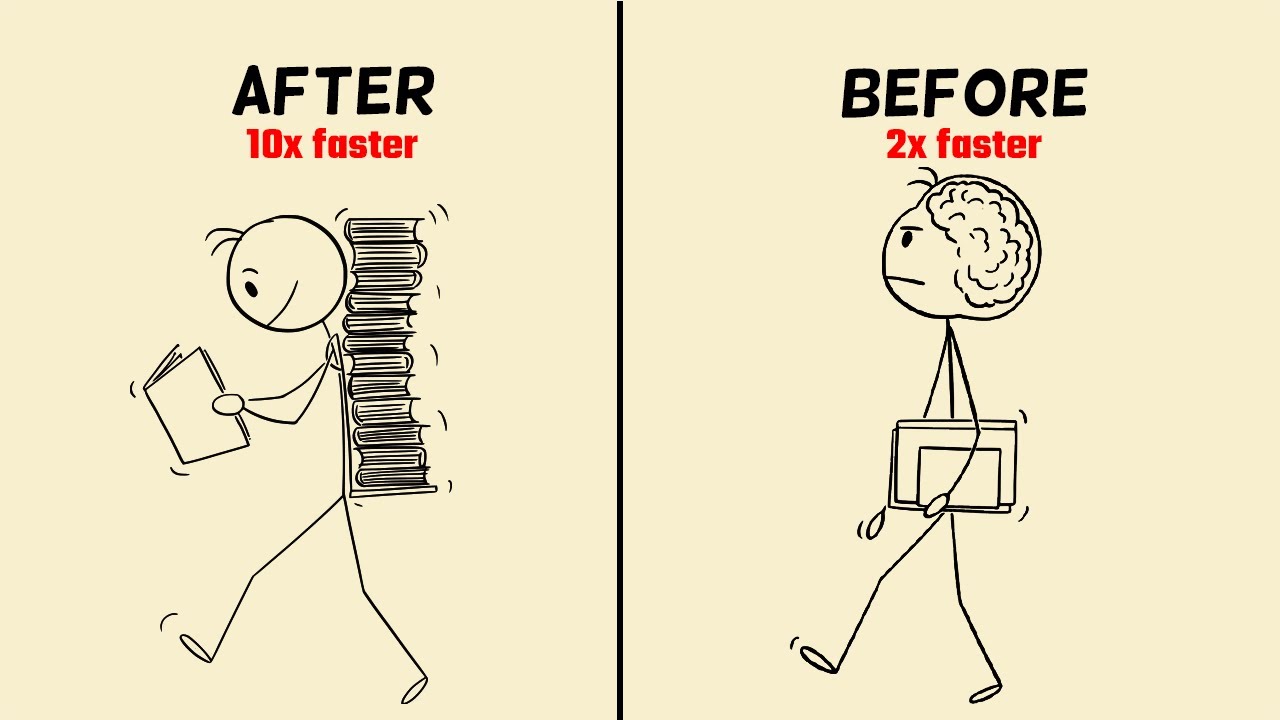
it only takes one night…
Quentin Tarantino's all-night brutal self-assessment ritual can rewrite your life if you list problems, brainstorm 100 fixes, and execute.
Key takeaways
3 points- 1Conduct one all-night session of ruthless self-assessment.
- 2Force at least 100 solution ideas per problem identified.
- 3Execute the chosen changes instead of stopping at the list.
Summary
The Tarantino Method uses a single night of harsh self-review to rewrite your story, just as it propelled Quentin Tarantino from video-store clerk to filmmaker.
Core Ritual
- Need only pen, notepad, and the dead of night for uninterrupted focus (0:00-0:45)
- Ask "What am I doing wrong?" and answer with brutal honesty
From Problems to Fixes
- Generate at least 100 concrete ways to correct each issue (1:00-1:40)
- Convert every mistake into actionable steps
The Real Work
- Implement the list instead of stopping at ideas (1:50-2:23)
Deep read
Executive Summary
The video presents a high-impact, one-night personal transformation framework inspired by Quentin Tarantino’s rise from a video-store clerk to a Hollywood icon. The core idea is to seize a silent night to brutally audit one’s life, identify what’s wrong, and generate a concrete set of 100 changes. The method emphasizes minimal setup (a pen, a notepad, and the quiet of the night), ruthless honesty about failures and fears, and a relentless focus on execution. While Tarantino's life serves as a motivational exemplar, the practical takeaway is a repeatable process: document flaws, brainstorm actionable changes, and commit to doing them. The piece also points viewers to an external Step-by-Step Guide and foregrounds the importance of translating insight into action rather than lingering in analysis.
The overarching message is clear: with the right conditions and disciplined output, ordinary people can catalyze meaningful personal growth in a single, well-spent night. The process is presented as scalable and adaptable, provided one maintains the commitment to actual execution after the night ends.
00:00:00Major Topic
Description: This video narrates Quentin Tarantino's popularized idea of a transformative, one-night method to overhaul a life—emphasizing honesty, ruthless self-assessment, and immediate action. The host frames Tarantino as a once-average video-store worker who rewrites his life in a single night, and then lays out a practical, three-item setup (a pen, a notepad, and the quiet of the night) to begin the process.
Key idea: a single, focused, all-night session can be a catalyst for meaningful change if you stop making excuses and commit to concrete steps.
00:00:15SubtopicThe Tarantino Trigger - One Night, One Decision
- The speaker positions Tarantino as a symbol of possibility: someone who rose from obscurity to iconic status through deliberate self-work.
- The core narrative: one night of focused effort can rewrite a life story that otherwise seems ordained by circumstance.
- The motivational frame hinges on removing excuses and using quiet, uninterrupted time to both identify and reframe life goals.
"Quinton Tarantino one of the most acclaimed filmmakers of all time known for bringing his bold ideas to life with surreal visuals and mind-bending storytelling but he wasn't always a Hollywood icon once he was just an ordinary guy working at a video store until one night he decided to rewrite his story" (Intro narrative sync)
00:00:30SubtopicCore Process and Tools
- Needs three things: a pen, a notepad, and the dead of night when the world is silent and not a soul is awake. The metaphor emphasizes quiet, interruption-free space for reflection and planning.
- The phrase "the dead of night" is presented as a symbolic clearing—conditions that reduce distractions and heighten honesty with oneself.
- The method’s promise: this setup creates a conducive environment for brutal honesty and fearless cataloging of one’s flaws and missteps.
00:00:45SubtopicThe First Page is the Hardest
- The first page is described as the hardest part because it requires you to begin (the act of initiating change).
- The initial step is to ask a powerful, fear-filled question: "What am I doing wrong?" This is framed as the crucial entry point for honest self-examination.
- Emphasis on honesty: the host urges brutal honesty about all self-lailings, procrastinations, and failures.
- The line between thought and paper action is stressed: the goal is to externalize fears and mistakes into tangible, inspectable material on the page, not keep them as internal narratives.
"what am I doing wrong" (direct quote of the big scary question)
00:01:15SubtopicThe Process of Change (Two-Part)
- After laying out fears and past mistakes, the next phase is to articulate how to change them. This is framed as a practical, analytic step, not a period of rumination.
- The speaker acknowledges that most people are not Tarantino and may feel exhausted or "written out." The remedy is a simplified approach: create a straightforward list of 100 ways to change.
- The process is framed as iterative: take a misstep or lesson, write down a change; repeat for each item until you have 100 actionable changes.
- The emphasis is on output (writing down steps) and scale (100 different tactics) to guarantee options when implementing change later.
00:01:30SubtopicThe 100-Way Change List (How-to)
- For each mistake or lesson, write down one concrete change that would alter the outcome.
- The idea is not to overthink each entry; the key is to generate many options and cultivate a habit of action.
- The process encourages ongoing reflection: adapt, reflect, learn, and grow as you repeat the exercise.
- The mantra: you will likely end up with many ideas, but the critical hinge is actually executing them.
00:01:40SubtopicThe Critical Reminder — Do It
- The method culminates with a fundamental rule: you must actually do the changes you list.
- The closing reminder is to translate insight into action; without execution, the exercise remains theoretical.
"let's make this part simple a straightforward list 100 ways you can change your life" (instructional cue) "the one very important thing you need to remember throughout this whole night you got to actually do it" (execution imperative)
00:01:50SubtopicGuardrails and Realistic Expectations
- The video juxtaposes Tarantino's extraordinary life with the viewer's ordinary circumstances, highlighting the need for pragmatic scalability when applying the method.
- It acknowledges common resistance (fatigue, excuses) but maintains the stance that honest self-review plus concrete action is accessible to ordinary people.
00:02:05SubtopicPractical Takeaways and Outcomes
- The framework is presented as a blueprint for personal reinvention, not a guaranteed overnight miracle.
- The method centers on disciplined self-diagnosis, transparent journaling, and a relentless focus on actionable steps.
00:02:20SubtopicFinal Prompt and Call-to-Action
- The closing segment reinforces urgency: the night is the time to begin, but the lifelong impact depends on continued effort after the night ends.
- The video suggests following or replicating the Tarantino method via the linked Step by Step Guide as a practical extension of what was discussed.
"you have to actually do it" (closing imperative)
00:02:40SubtopicVisual/Audio Cues to Recreate the Experience
- The narrative uses pacing, pauses, and musical cues (e.g., [Music]) to emphasize the tension and momentum of the night-long process.
- While no diagrams are shown, the structure can be recreated as a mental model: prepare materials → confront fears → generate 100 changes → commit to action.
00:03:00SubtopicSummary Points and Takeaway
- The Tarantino Method centers on a one-night, high-intensity reflection exercise.
- The three required items are intentionally minimal to lower barriers to start.
- The key cognitive shift is moving from internal critique to external documentation of flaws, followed by a large set of concrete actions.
- Execution is the essential hinge: without doing the work, insights do not translate into life change.
00:03:15Resources Mentioned
- External Resource: Step by Step Guide: https://whop.com/thetarantinomethod
- The video presents Tarantino as a case study for personal reinvention and references a modern framework or method for applying this approach to one’s life.
00:03:30Reusable Takeaway Framework
- The Tarantino Method can be captured as a repeatable personal-development framework:
1) Create the space (quiet, distraction-free night). 2) Start the first page with brutal honesty about what you’re doing wrong. 3) List 100 concrete changes to implement. 4) Adapt, reflect, learn, and grow from each change. 5) Do not stop; execution is the differentiator between insight and transformation.
Resources Mentioned
- https://whop.com/thetarantinomethod
- Tarantino (as a broader reference to his life story and approach to bold ideas and storytelling)
00:03:45Note on Terminology and Concepts
- Dead of Night: a metaphor for a silent, distraction-free period when deep work is possible.
- Fear-mongering question: a way to frame the most intimidating self-inquiry to force honest self-assessment.
- 100 ways to change: a high-volume intervention technique designed to break paralysis and surface actionable ideas.
- Adapt, reflect, learn, grow: iterative feedback loop common in personal development; high-emphasis cycle for continuous improvement.
00:04:00Visualizing the Narratives and Analogies
- Analogy: a normal person can rewrite their life story in a single night much like a filmmaker reinvents a project; the contrast between a video-store clerk and Tarantino’s blockbuster success is used as a compelling story device to motivate viewers.
- The narrative’s tone favors urgency and possibility over pomp, using a practical toolkit (pen, notepad) as a symbol of agency.
00:04:15FINAL THOUGHTS
- The video presents a blueprint for rapid self-reinvention anchored in honesty, small steps, and high-output experimentation.
- The Tarantino life story is used to convert a cinematic example into a practical method for everyday life, with the caveat that sustainable change requires actual action.
"the dead of night when the world is silent and not a soul is awake that's when it can happen" (core setting description)
Action Items
- Set aside a quiet, distraction-free night for self-review.
- Grab a pen and notepad; prepare to write without judgment.
- Write the prompt: 'What am I doing wrong?' and answer it honestly.
- List all fears, doubts, mistakes, and lessons—get everything on paper.
- Create a new list of 100 concrete changes that could fix the identified issues.
- Commit to at least one change tonight and plan its first actionable step.
- Review and refine the 100 changes over time; discard or modify plans that prove impractical.
- Repeat the process as needed to maintain momentum and growth.
Mental Models
Glossary
- Dead of Night
- A quiet, distraction-free period late at night used as a metaphor for deep, focused self-work.
- Fear-mongering Question
- A deliberately intimidating question designed to strip away excuses and reveal honest self-assessment.
- 100 Changes
- A list of one hundred concrete actions to alter outcomes, created to overcome paralysis and generate practical steps.
- Execution
- The act of carrying out plans and changes in real life, not just thinking or planning.
Notable Quotes
“"what am I doing wrong"”
“"you have to actually do it"”
“"let's make this part simple a straightforward list 100 ways you can change your life"”
“> what am I doing wrong”
“> you got to actually do it”
Topics
More from Polymath
See all