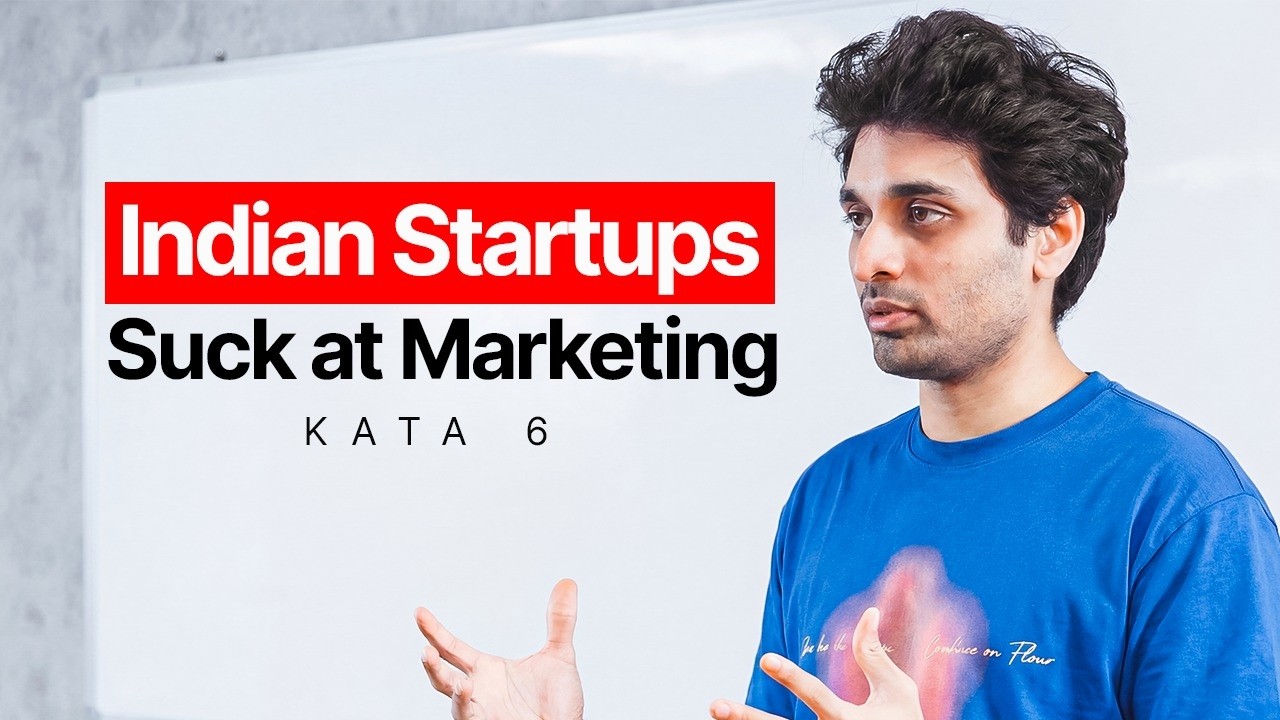
Career Advice for People Who Feel Lost | Kata 7
Clarity beats confusion by picking one path and committing long enough for it to compound instead of chasing endless options.
Key takeaways
7 points- 1Confusion is the default state created by too many options, not lack of talent.
- 2Commit to one thing long enough for it to compound before adding more.
- 3Use Essentialism and The One Thing to eliminate non-essential pursuits.
- 4Label decisions one-way or two-way doors and decide fast on reversible ones.
- 5Run time-boxed 60-day sprints instead of endless analysis.
- 6Prioritize growth rate over absolute scale in early career choices.
- 7Clarity emerges after action, never before the decision.
Summary
Young professionals stay stuck because infinite options and hyper-gambling create paralysis, not because they lack ability.
The Confusion Trap
- Overwhelming opportunities plus constant external noise keep people in indefinite optimism, collecting credentials without plans (0:00-10:01).
- Hyper gambling on 100x moonshots replaces steady building and leads to zero impact.
Core Frameworks
- Peter Thiel's four quadrants separate definite optimists who plan and build from indefinite optimists who wait for luck (0:00-10:01).
- Essentialism and The One Thing force elimination of everything that is not a "hell yes" (10:01-20:03).
Freelancer's Trap & Optionality Poison
- Juggling multiple revenue streams too early destroys depth and turns into constant sales work with high non-payment risk (10:01-20:03).
- Maximum optionality produces minimal results; diversification only works after one stream is solid.
Anti-Confusion Playbook
- Label decisions one-way or two-way doors, run 60-day curiosity sprints, then default to build-ship-feedback (30:07-36:41).
- Follow the Rule of Three for serious projects and always favor growth rate over absolute scale.
Deep read
Executive Summary
Varun Mayya’s Kata 7 session addresses a universal pain point: the feeling of being lost in a world of abundant opportunities. He argues that the core problem is not lack of ability but the inability to decide and commit, which leads to paralysis and diluted impact. The talk distinguishes confusion from healthy diversification, recommending a disciplined shift from chasing everything to choosing one lever that, when honed, unlocks broader possibilities. Drawing on Peter Thiel, Greg McKeown, Gary Keller, and Bezos, the talk builds a practical anti-confusion playbook: treat decisions as one-way vs two-way doors, embrace time-bound curiosity sprints, and pursue the one thing that makes everything else easier. The message is action-first: clarity arises from taking decisive steps, then leveraging momentum to broaden impact intelligently. The closing takeaway is that rapid decision-making and focused execution can yield rapid personal and professional growth, especially in a world of exponential opportunities.
00:00:00 Major Topic: Introduction and purpose of the talk
Varun Mayya sets the stage: 99% of people are confused, and clarity is what separates high performers once they gain it. The audience is told: clarity does not come before action; it comes after you commit and start. The speaker uses the framing of modern career confusion—many exciting options, fear of making the wrong choice, and the cost of chasing too many paths—to propose a disciplined approach to decide, commit, and then diversify from a strong base.
- Key ideas introduced:
- Confusion is common in early career; clarity is a competitive edge. - You must try things through experimentation, but you should structure your experimentation to avoid forever spinning without impact. - The difference between genuine diversification and mere confusion is that diversification has a working core and a plan, while confusion lacks a solid center. - The stance toward risk is pragmatic: you should differentiate between small experiments and big, irreversible commitments.
Notable line (verbatim, first major point): "The minute you're in your third job, for most people that's their career. Because beyond the third job, experimenting in more fields is not going to change who you are."
00:55 Major Topic: The Confusion
- The Confusion problem in early career years (20s–mid-20s) is framed as the central obstacle to progress.
- A concrete analogy is used: in a modern attention economy, opportunities are everywhere, which amplifies paralysis.
- The speaker emphasizes that many people don’t lack ability; they lack a decision and a commitment to one path long enough to generate results.
- Emphasis on the trade-off between trying many paths at once and focusing on a single lever with multiplicative impact later.
01:23 Major Topic: Hyper Gambling
- Definition of hyper gambling: taking large, high-risk bets with the hope of outsized payoff, driven by impatience to achieve wealth or status early.
- The talk distinguishes between good high-risk bets (e.g., ambitious startups funded by VCs) and bad hyper gambling (e.g., reckless financial bets).
- The speaker empathizes with the pressure to seize big opportunities because of an abundance of online success stories and FOMO (fear of missing out).
- The core idea is to recognize when a risk is a genuine path to exponential growth (like a startup with VC backing) versus when it’s a personal riff that can derail long-term progress.
Notable line (verbatim, first major point): "The world is filled with opportunities and every day you're hearing about somebody who invested in something and it went 100x. There's so much FOMO in the world."
04:05 Major Topic: Confusion vs Diversification
- Distinguishing confusion from diversification:
- Confusion: multiple options that are interesting but none have a working impact or P&L (profit and loss) record. - Diversification: one primary path working well, with additional areas pursued without harming the core (i.e., income or skill growth remains stable).
- The discussion uses freelancing as a concrete example: many freelancers chase multiple freelance gigs, which can erode core revenue or lead to unstable income streams if not managed carefully.
- The speaker shares internal company practices to illustrate diversification as a non-disruptive expansion: adding new projects only after stabilizing the existing core.
04:46 Major Topic: Peter Thiel's 4 Quadrants
- Peter Thiel’s framework is introduced to categorize worldview toward the future and personal plans:
1) Definite optimist: believes the future can be better and has a plan to make it better—productive and ambitious projects (railroads, iPhone, SpaceX). 2) Indefinite optimist: believes the future will be better but without a concrete plan. 3) Credential collector (a form of luck-seeking): believes it will be good, but relies on credentials or resumes to attract luck. 4) Definite pessimist: believes the future is bleak but has a plan, often preparing for survival measures. 5) Indefinite pessimist: believes the future is bad, with no plan.
- Varun places himself in the definite optimist camp with a plan and a belief in AI-driven progress, while recognizing others may be uncertain or risk-averse.
- The key takeaway: aligning with a definite plan for a better future helps navigate confusion and commit to a path.
Notable line (verbatim, first major point): "There is a definite optimist. The view of the future is future can be better. Do they have a plan? Yes."
08:49 Major Topic: Greg McKeown's Essentialism
- Core concept: essentialism is the disciplined pursuit of less, but better. Indecision is reframed as the undisciplined pursuit of more.
- The cure is systematic elimination: every decision should meet a high threshold (nine out of ten on a personal hell-yes scale). If not, it’s a no.
- The principle is a powerful filter: every extra option becomes a tax on your energy and willpower; reducing options increases impact on the chosen path.
10:43 Major Topic: Gary Keller's The One Thing
- The One Thing principle is presented as a way to weaponize optionality, focusing on the single task that makes everything else easier or unnecessary.
- The idea is not to abandon other interests, but to identify the one thing that enables those interests to flourish.
- The example: EOS (Entrepreneurial Operating System) uses this approach to prioritize what is most impactful, e.g., hiring a video editor only when the core needs demand it.
11:44 Major Topic: The Freelancer's Trap
- The Freelancer’s Trap is a cautionary note on freelancing: while freelancing can deliver high income, it comes with higher risk and volatility.
- In freelancing, there is a real risk of late or non-payment by clients, especially for smaller freelancers lacking a brand or negotiating power.
- Diversification is critical: you need multiple projects/clients to stabilize revenue; relying on a single freelance client can be financially dangerous.
- The talk emphasizes that larger, reputable clients tend to pay reliably and on time; smaller clients may delay or default.
- The author argues that true diversification is earning income without abandoning your core job and income stream.
- The discussion links diversification to the broader concept of risk management and operating as a small business rather than a pure freelancer.
18:57 Major Topic: Clarity as Your Competitive Edge
- The central claim: clarity is achieved by making hard calls and taking action; once you commit, you gain leverage and can grow into more opportunities.
- The speaker emphasizes founder-driven behavior: those who take initiative and own decisions are rewarded; the opposite—blaming others or not committing—leads to stagnation.
- The advice is practical: be willing to take hard calls, ask for forgiveness if needed, and be prepared to back up decisions with evidence and results.
28:47 Major Topic: The Anti-Confusion Playbook
- The plan to fight confusion includes 8–9 actionable rules:
- One-way doors vs. two-way doors: categorize decisions by reversibility; implement with the least irreversible approach first where possible. - Personal OKRs: one objective, three key results to keep decisions focused. - Time-boxed curiosity sprints: give yourself a fixed window (60 days) to explore a field; commit or reject afterward. - Default to build, ship, and feedback: ship something tangible to gain feedback faster than endless planning. - The Rule of Three: date or ship three serious options before deciding; sampling beyond three often reduces clarity and increases opportunity cost.
29:07 Major Topic: One-Way Doors vs Two-Way Doors
- Bezos’ concept: one-way doors are irreversible decisions; two-way doors are reversible decisions that can be undone or corrected.
- The advice is to treat most career moves as two-way doors if you can revert, but some are genuinely one-way and require deeper consideration.
- The guidance is to move decisively when you have leverage and a track record; otherwise, act quickly but with enough information to back up the move.
32:34 Major Topic: The Rule of Three
- The Rule of Three suggests sampling three serious options/projects maximum; beyond three, the marginal gains in clarity drop, and opportunity costs rise.
- The underlying logic is that after trying three well-chosen paths, you’ll have enough signal to make a decision with confidence.
34:03 Major Topic: Growth Rate vs Absolute Scale
- The talk contrasts growth rate (speed of growth) with absolute scale (size of the company).
- Fast-growing startups (exponential growth) offer rapid opportunities and a chance to learn, own responsibilities, and advance quickly, but they can be volatile.
- Large, established companies offer stability but slow growth; the choice depends on whether you want rapid learning and risk versus stability and steady progression.
- The speaker uses Emergent as an example of a rocket-like growth trajectory and argues for seeking exponential growth environments when possible.
35:46 Closing Thoughts
- The closing frame: once you make a choice and a path shows results, others will follow; you gain credibility and new opportunities will emerge more easily.
- A practical takeaway: focus on one thing that works, then layer new things on top, leveraging the momentum and reputation you’ve built.
- The talk ends with a personal note on how decisive moves early in a career can set you apart for years to come.
Resources Mentioned
- Peter Thiel's Four Quadrants (as described in the talk): Definite Optimist, Indefinite Optimist, Credential Collector, Definite Pessimist, Indefinite Pessimist.
- Greg McKeown, Essentialism: The disciplined pursuit of less but better; nine-out-of-ten hell-yes criterion.
- Gary Keller, The One Thing: Focus on the single most important thing that makes everything else easier.
- The Freelancer's Trap: A concept (and a book discussed in the session) about the risks of freelancing without sufficient diversification.
- The Unaccountability Machine: A book that discusses how large organizations develop decision processes that erode ownership.
- EOS (Entrepreneurial Operating System): A framework used to align teams and focus on what matters most.
- Jeff Bezos' concept of One-Way Doors vs Two-Way Doors: decision irreversibility and reversibility.
- Y Combinator and venture-backed startup dynamics as examples of high-variance opportunities.
- Emergent (a client example) as a case study for exponential growth opportunities.
- Counter-Strike economy example (an analogy in a separate metaphor about value systems and communities).
- Dangers of “infinite scroll brain” from social media and the impact on decision fatigue and opportunity overwhelm.
Notable Visuals or Diagrams (described)
- Four-Quadrant mindset diagram illustrating Thiel's quadrants: definite optimist, indefinite optimist, credential collector, definite pessimist, with arrows showing potential paths and plans.
- A flow chart-like mental model of Essentialism showing a filter: nine-out-of-ten hell-yes = do it; anything less = no. This is a decisional filter to prune options.
- The One Thing diagram showing how solving one high-impact lever makes other tasks easier or unnecessary, thereby depressing the importance of chasing multiple goals simultaneously.
- A decision map comparing One-Way Doors vs Two-Way Doors: arrows labeling decisions as reversible or irreversible, with guidance on timing and risk.
- The Rule of Three visualization: a three-column checklist of three major options, with criteria and outcomes, illustrating how sampling beyond three becomes costly.
- Growth-rate vs absolute-scale chart: comparing startups at high growth rates against slow-growing incumbents to illustrate opportunity dynamics.
Key Definitions (inline where first used)
- Hyper gambling: taking large, high-risk bets with the hope of outsized payoff (often ill-advised for individuals due to risk and time horizons).
- Confusion: lack of decisive focus across many viable options; typically results in no action and little impact.
- Diversification: expanding into additional areas or income streams in a way that does not erode the core, maintaining stability while enabling growth.
- Essentialism: a disciplined approach to doing less but better, guided by a stringent criterion (nine-out-of-ten hell yes).
- The One Thing: a framing that identifies the single most impactful task that enables easier progress on other objectives.
- Freelancer's Trap: the risk and volatility inherent in freelancing without broad client base or reserves; diversification is essential to avoid boom-bust cycles.
- One-Way Door: a decision that is irreversible or very costly to reverse; requires careful consideration.
- Two-Way Door: a reversible decision that can be undone with relative ease.
- EOS (Entrepreneurial Operating System): a framework for running a business that emphasizes clarity, accountability, and focus on core tasks.
- The Unaccountability Machine: a concept describing how large organizations become process-driven, leading to diffusion of decision ownership.
- Growth Rate vs Absolute Scale: the dynamic difference between rapid growth opportunities and the scale of an established organization.
- Rule of Three: the guideline to sample up to three serious paths/projects before committing.
Verbatim Quotes (examples)
- > Your job is to avoid being affected by this. (00:01:45, Varun Mayya)
- > The minute you're in your third job, for most people that's their career. (00:18:15, Varun Mayya)
- > There is a definite optimist. The view of the future is future can be better. (00:04:46, Varun Mayya)
- > Confusion is not accidental, and in many companies it's baked into avoid blame. (00:19:10, Varun Mayya)
- > Decide and you’re ahead of 99% of the population. (00:33:50, Varun Mayya)
Additional Notes on Structure and Visuals
- The talk often refers to slides and decks; the deep_read attempts to translate those visuals into textual bullets and timelines to preserve the logical flow for study.
- The speaker uses personal anecdotes and company-wide practices to ground abstract frameworks (e.g., EOS adoption, one-thing focus in project hiring, and the Freelancer's Trap as a cautionary example).
- The content uses a blend of macro career theory (Thiel, McKeown, Keller) with micro-practical strategies (OKRs, 60-day sprints, one-way vs two-way doors) to create an integrated playbook.
Summary of the Anti-Confusion Playbook (quick reference)
- Classify decisions as one-way or two-way doors and act accordingly.
- Use personal OKRs with one objective and three key results.
- Run 60-day time-boxed curiosity sprints to explore fields before committing.
- Default to building, shipping, and gathering feedback to de-risk purely theoretical planning.
- Exercise the Rule of Three before deciding; avoid infinite sampling.
- When choosing, consider growth rate and exponential opportunities for faster career progression.
- Recognize that clarity is often achieved through decisive action rather than passive waiting.
Final Reflection
- The core message is simple yet powerful: pick one path that has credible upside, commit to it, and prove it until you gain momentum. Once you have a foothold, you can responsibly expand into related areas without losing your core trajectory. The talk reframes career decisions as a sequence of testable bets rather than existential, all-or-nothing gambles.
Action Items
- Choose one path you will go all-in on for the next 90 days and write a commitment statement.
- Apply the 'nine-out-of-ten hell yes' criterion to every new opportunity before saying yes.
- Categorize major decisions as One-Way Door or Two-Way Door; reserve irreversible actions for high-signal cases.
- Set a Personal OKR: one objective with three measurable results for the next quarter.
- Run a 60-day curiosity sprint to explore a new field; decide to continue or pivot at the end.
- Build a stable core (three to four solid projects/clients) before adding new ventures.
- If freelancing, secure at least three revenue streams and establish payment terms to avoid cash flow gaps.
- Prioritize growth-rate opportunities (exponential) over slow, stagnant roles when seeking rapid advancement.
- Document your decisions and outcomes; use feedback to refine your next set of bets.
- Practice the 'answer first, refine later' approach: start with action, then align with permissions or approvals when necessary.
Mental Models
Glossary
- Hyper Gambling
- High-risk, high-reward bets intended to achieve outsized returns quickly, often with low probability of success.
- EOS
- Entrepreneurial Operating System: a framework to organize a business around clear priorities and accountability.
- P&L
- Profit and Loss; a simple way to measure whether a venture is financially on track.
- Definite Optimist
- Believes the future can be better and has a plan to make it better.
- Indefinite Optimist
- Believes the future will be better but lacks a concrete plan.
- Credential Collector
- Focuses on acquiring credentials to attract luck, rather than building a demonstrated track record.
- Freelancer's Trap
- The risk of freelancing where income is volatile and dependent on client payment and repeat business.
- The Unaccountability Machine
- A concept describing how large organizations build processes that diffuse decision ownership and slow progress.
Notable Quotes
“The greatest problem facing youngsters today is confusion.”
“Your job is to avoid being affected by this.”
“There is a definite optimist. The view of the future is future can be better. Do they have a plan? Yes.”
“Decide and you’re ahead of 99% of the population.”
“Confusion is not accidental, and in many companies it's baked into avoid blame.”
“The minute you're in your third job, for most people that's their career.”
Topics
More from Katas
See all